Monday, April 6, 2020

#AuthorInterview with Gary D. McGugan @GaryDMcGugan

Today, Feathered Quill reviewer Diane Lunsford is talking with Gary D. McGugan, author of The Multima Scheme (Book 2 in The Multima Trilogy of Corporate Intrigue).

FQ: Once again, I want to thank you for yet another enjoyable read. The returning characters have added depth and the ‘freshman class’ is keeping pace quite nicely with the old timers. I’ve noticed you plant a few seeds along the way to tie the story line to actual current affairs both politically and economically. Have you had any fans make mention that some of the situations are quite parallel with real life? If so, how do you respond to such observation(s)?

McGUGAN: Thanks for your kind words, and thank you again for an opportunity to chat with you and your audience. Yes, readers often comment about how plausible some passages in each of my stories might be. Although novels are works of fiction, I think stories are always more potent if scenarios and actions all seem plausible. My stories all stretch credulity a bit to make them exciting. But I try to validate plausibility with references to current events or well-known figures in a way that readers easily recognize. I think of it as part of the art of telling a story!

FQ: Considering the current pandemic, what creative ways have you come up with in promoting The Multima Trilogy (aside from social media) to keep a quasi-tangent connection with your fan base?

McGUGAN: Great question! And I wish I had an answer showing brilliant foresight and profound perceptiveness. Unfortunately, at this stage, I have neither. Since the arrival of the pandemic, my focus has been the completion of Pernicious Pursuit, my fourth novel. Until only a few weeks ago, I was planning to promote all my books with author events at bookstores. Indigo stores in Canada had already booked more than 35 dates for the Spring of 2020. That strategy must change as this pandemic will be with us for some time. Feathered Quill is part of my alternate approach. Working with sites like yours, I hope to attract new readers to all my novels, and I value your interest and support!

FQ: In line with my previous question, what social media platform is your ‘go to’ means for messaging? Why?

McGUGAN: Facebook is my primary platform (@gary.d.mcgugan.books). Twitter (@GaryDMcGugan) is another medium I enjoy and use. And Instagram is the most recent platform I’ve embraced. (authorgarydmcgugan). I favor Facebook primarily because it has a useful events tool that helps me promote author signing events effectively.

FQ: We learn in Three Weeks Less A Day that Howard Knight got himself in quite a pickle toward the end. Why bring his wife into the mix to lie for him when he decides to flee the country?

McGUGAN: Howard Knight has human shortcomings and we can often question his judgment. But he has a streak of brilliance, reads people well, and anticipates the FBI will come looking for him. He also predicts correctly that his executive assistant will call his home to see if he was delayed. His wife doesn’t realize she’s telling a lie when she relays her understanding of events. 

There’s nothing unusual about a person in Howard’s position calling his wife at the last minute to let her know he won’t be home for a few days. He intentionally lies about his destination, knowing his wife has no reason to doubt the information. To her, it’s just a ‘heads up’ that he won’t be home for a few days. Unintentionally, she passes on the misleading information.

FQ: In conjunction with Knight’s flight, why is his paramour, Fidelia Morales, the only one who was ever given a ‘pass’ to leave The Organization?

McGUGAN: Giancarlo Mareno, the kingpin of The Organization, is quite an interesting and complex character. To him, Fidelia Morales was much more than the woman who ran his call-girl operations around the globe. Clearly, her expertise generated phenomenal wealth for him. But, on some level, he was attached to her emotionally. It might not have been love that influenced his judgment, but some tender connection led him to grant her wish initially. The moment she betrayed his trust, she became an enemy and any emotional attachment evaporated immediately.

FQ: It seems that Multima has a stringent vetting process for new employees, yet moles for The Organization still manage to infiltrate the inner sanctum. Was it difficult to keep track of who was doing what and how did you manage to keep it all straight?

McGUGAN: You caught one of the dichotomies of large multinational corporations. Like most large companies, Multima has sophisticated screening and hiring processes for ninety-five percent of its new hires. But with most large companies, a few people have extraordinary influence. In the case of Multima, board director Howard Knight needed only to inquire about the possibility of a job for a protégé, good friend, or family member to the CEO. 

When any CEO then asks a human resources department to consider a candidate, that request almost always results in a quick and favorable hiring decision. It’s the way corporations work.

FQ: Without giving too much of a spoiler, there was quite the unmasking toward the relationship between Suzanne Simpson and John George Mortimer at the end of Three Days Less A Week.Did you work a couple of scenarios on how the plot would move forward with the information; particularly with Suzanne’s and Mortimer’s relationship? Why did you choose the path you chose?

McGUGAN: Sure. I thought through more than a couple scenarios before deciding on the one unveiled in The Multima Scheme. Ultimately, I wanted to create a complicated scenario for Suzanne Simpson to highlight her business acumen and extraordinary good judgment. Since my early days working in large corporations, I’ve always found women underrepresented in management hierarchies. One of the messages I like to include as an undertone in my writing is the great benefit women bring to organizations. I try to subtly champion why companies should promote more women to more prominent positions where they can exert greater influence on a company’s success.

FQ: In our first interview, you gave an intriguing answer to one of my questions that touched upon the audience you envisioned for this trilogy and your response was: ‘...I wanted Three Weeks Less a Day to appeal to an extensive demographic readership...’ How critical do you believe it to be in the writing process to have a distinct vision of who the intended audience is?

McGUGAN: I think it’s vital. A clear vision of the intended demographic helps develop the plot, the pacing of the story, and even with choices of individual words.

FQ: Think of a character you would consider for a future novel and describe what brings him or her to life.

McGUGAN: In Pernicious Pursuit, I introduce one new character named Nadine Violette, a trusting and naïve woman from the Caribbean island of Martinique. In the story, we learn how this college-aged young woman becomes a victim of human trafficking and her subsequent struggles to escape human bondage. We also see how misogynist criminal elements can change the trajectory of women’s lives quickly, dramatically, and permanently. I think readers will be very intrigued by the ways this character develops in the story.

FQ: I thoroughly enjoyed Book II, The Multima Scheme, and have taken the plunge into Book III, Unrelenting Peril. Knowing you were embarking upon the third and final book in the series, how difficult was it to write the proverbial ‘the end’?

McGUGAN: ‘The end’ sounds so final! Three Weeks Less a Day, The Multima Scheme, and Unrelenting Peril make up a trilogy designed around the goings-on at Multima Corporation. While I don’t currently have plans to enlarge the series around Multima, I plan to use some of the characters in those three novels in future stories. For example, in Pernicious Pursuit I take four of the naughtiest characters and launch them on a completely different trajectory of action and excitement. I think readers will enjoy reading about the ways the characters change and evolve in this very entertaining new action/suspense story. I hope Feathered Quill will read and review it soon!

FQ: Thank you again for your time and the pleasure of reading this fantastic series. I look forward to your future projects.

McGUGAN: It is I who thank you for the opportunity to chat with you and your audience.

Thursday, April 2, 2020

#AuthorInterview with Anthony J. Orsini @TheOrsiniWay


Today, Feathered Quill reviewer Barbara Bamberger Scott is talking with Anthony J. Orsini, author of It's All in the Delivery: Improving Healthcare Starting with a Single Conversation.
FQ: Do you use a fair dose of humor, as you did in your book, for speaking engagements regarding your method?
ORSINI: I always find that storytelling is a great tool for teaching. When you have practiced medicine for as many years as I have, there are many examples that I can draw from. The use of humor and my personal story further emphasize the points I am trying to express. Engaging the audience is very important during my presentations. 
FQ: Do you see in the medical practitioner/facility/patient interaction the possible development of something akin to a physician-priest/preacher?
ORSINI: Good rapport and mutual trust are the keys to any successful relationship. Without trust, all communication breaks down, and without good communication, there can be no success.
FQ: Do you have any true stories of compassionate doctors from the pre-sci/tech era that could be used as examples of Orsini principles?
ORSINI: In my book, It’s All in the Delivery, I tell the story of Dr. Anthony Merk, who practiced for five decades and was never sued for malpractice. Dr. Merk wrote his entire patient chart on 5 x 9 cards. He is a great example of how medicine is less about technology and more about a human to human connection. 
FQ: Would you recommend It’s All in the Delivery to those who work outside the medical profession but who might face similar person-to-person encounters in the workplace?
ORSINI: I wrote, It’s All in the Delivery, to help anyone who wants to learn how to communicate well. The principles of communication that I discuss not only apply to healthcare but to business leaders, salesman and frankly to anyone’s personal life. I have taught many of these principles to fortune 500 companies to teach their executives how to be effective leaders, how to create loyalty and, of course, how to have difficult conversations with their employees and staff. The principles I teach re-wire, if you will, the way we think of communication. They can be used every day. 
FQ: Do you have plans for more writing of a similar nature, or will you now be turning to other forms of media for outreach regarding the Orsini Way?
ORSINI: I do a considerable amount of communication workshops and an occasional webinar. My focus right now is to do more keynote speaking engagements and training for both medical and non-medical people.
FQ: Could you envision a feature length film illustrating your own life experience and development of the Orsini Way (companion to the book)? Or a dramatic film depicting a typical over-stressed hospital environment or doctor/patient miscommunication in which the Orsini Way saves the day?
ORSINI: A film about a doctor who is fighting the system to keep communication and compassion above efficiency is an intriguing idea. The truth is that everyone learns how to communicate better; we can all benefit. 
FQ: Is your career transitioning now from medical practice to training?
ORSINI: Right now, I am still a practicing physician, and I love what I do. Although I save premature lives every day, I feel that teaching compassionate communication is something that I am gravitating toward more and more. I truly think that by teaching the principles in my book, I can have an even bigger impact on medicine. Every doctor I train has an estimated 250,000 patient encounters before they retire. If you add up all of the nurses, therapists, and even business people that I have trained, the positive impact that I can have is staggering. I have something that is proven and works. I want to share it. 


#BookReview - It's All in the Delivery @TheOrsiniWay

It's All in the Delivery: Improving Healthcare Starting with a Single Conversation

By: Anthony J. Orsini, D.O.
Publisher: West Essex Press
Publication Date: March 2020
ISBN: 978-1-09830-447-8
Reviewed by: Barbara Bamberger Scott
Review Date: March 20, 2020
Anthony Orsini, the author of the fact-filled book It's All in the Delivery, is a medical practitioner who has devised his own method of patient care based on better communication.
Anthony J. Orsini, whose memories comprise a portion of this guide, always wanted to be a doctor, and undertook one of its more difficult specialties, neonatology. In that field, there were many stressful occasions to give bad news to parents of a newly born or very young infant. That, and an experience he had had during his studies of observing a doctor he much admired conveying bad news badly and admitting it, gradually spurred him to tackle the problem of practitioner-to-patient interaction as his personal passion.
In a brief historical survey, Orsini points out that only recently, in the late 19th century, did science begin to undertake compassion as a major component of a doctor’s methodology. Once modern medicines and new technologies were discovered and “doctors were holding instruments instead of hands,” the template for medical practitioners became a generally accepted neutralization of feelings. This trend continued, until some stumbling blocks arose, among them the recent trend for medical facilities to conduct patient surveys that emphasize customer service. Another is malpractice suits, 71% of which, Orsini reports, are based around miscommunication on the part of the physician.
Learning of a training program using actors, often amateurs, to play the role of patients so that prospective doctors could practice delivering bad news, Orsini went a step further, engaging professional actors and setting up realistic situations for training residents and senior physicians. This facilitated the gradual design of The Orsini Way, also known as “Breaking Bad News: P.R.O.G.R.A.M.” The acronym stands for Plan/Position, Review, Observe, Gradual/Genuine, Relationship, Accountability, and Meet. These steps, illustrated in text and photographs, are based on three essential principles: the patient/family should feel that the medical practitioner understands and cares, that s/he is the expert and will lead them to the next steps, and that s/he will not abandon them.
Orsini’s vivid medical case studies lend credence to his highly organized text, underpinned by the positive testimonials of participants in his BBN P.R.O.G.R.A.M. He offers simple directives for a practitioner-patient/family session: set up chairs in preparation for a meeting; make sure the doctor is positioned close to the family, not at a “professional” distance; reach out with the hand to symbolize compassion rather than holding it up as a signal of control; break bad news gradually; imagine oneself in the situation of the person receiving the news; and make a commitment to stay in touch through all future phases of treatment. The BBN P.R.O.G.R.A.M, so clearly delineated, promises authentic outcomes, not only to practitioners searching for new approaches, but for anyone who has ever been a patient, hoping for a sense of security and real comfort when it is most needed.
Quill says: Orsini’s method has already met with acclaim and his book will doubtless find a solid niche in a new age of medicine, as outreach and communication will take their rightful place in patient care.
For more information on It's All in the Delivery, please visit the author's website at: https://theorsiniway.com/

#BookReview - The Gray Chamber (True Colors)

The Gray Chamber (True Colors)
By: Grace Hitchcock
Publisher: Barbour Books
Publication Date: January 2020
ISBN: 978-1-64352-235-7
Reviewed by: Skyler Boudreau
Review date: April 2, 2020
It’s the 1880’s, and Edyth Foster is a wealthy, thriving, woman in New York. Much to the scorn of her peers, she makes a habit of going against the grain and engaging in typically masculine pursuits like fencing. When her uncle, responsible for the fortune Edyth’s parents left her until her twenty-fifth birthday, finds a loophole in their will allowing him to claim the fortune instead, he takes full advantage of it. Edyth is sent away to an insane asylum, both removing her from the picture allowing him full access to her fortune and putting an end to her eccentric behavior.
During this time period, women were expected to fully submit to the demands of an exclusively male-dominated society or risk being labeled “problematic.” An abundance of men chose to have their “problematic” sisters, wives, and daughters committed to insane asylums. The women were placed there with ill-intentions, not because they were genuinely struggling with their mental health, but to silence them and as punishment for not following the strict demands that their toxic culture placed on them.
Asylums were also used to get women out of the way of their male relatives. Men could commit their wives if they became interested in a different romantic partner and didn’t want to cheat. In The Gray Chamber, Edyth’s Uncle Boris has her committed because a stipulation in her parents’ will allows their fortune to pass to him rather than her if she either dies without children or is diagnosed as insane and sent to an asylum. A woman’s word was not taken seriously during this time. They were often dismissed as hysterical, as Edyth is throughout the novel. Commitment was a simple solution to a man’s problem with a female relative, and one that was difficult for a woman to fight against.
Author Grace Hitchcock paints this difficult history in broad and commanding brush strokes. She forces the audience to reflect on this dark time period and what it did to half of the population. She explores how easy it was for men to take advantage of their power within society and have women locked away for their own financial, personal, or political gain. She fearlessly guides her readers into this era and when her audience emerges, they will do so with a new interest in women’s history.
The Gray Chamber also explores the difficulty women faced when entering a predominantly male field. Edyth is very interested in fencing. She is one of the best students in her friend Bane’s fencing club. It’s not a hobby that is considered fitting for a young woman, and she faces opposition from not just her family and peers, but from some fellow club members as well. During a scene in the beginning of the novel, one of the other fencing students is rude to her. Upon expressing her discomfort, he responds with, “‘Please. We all know, Edyth, that you are one of the boys. No need to pretend you don’t hear worse, but it is a shame that you don’t dress up more often.’” (pg. 54) This is a common occurrence even today. Her male peer harasses her because of her gender and then tries to laugh it off by claiming she is one of them. He doesn’t respect her because of her gender, and then tries to ignore it as an excuse for the harassment. Hitchcock makes a point to address similar gender issues and inequities throughout the novel.
While The Gray Chamber places wonderful emphasis on these cultural issues, it does have some weaknesses. A lot of the action sequences are cut out completely. There’s a scene where a detective is hired to sneak into the asylum where Edyth’s friends suspect she is imprisoned. He needs to find a way into the asylum and a safe way to sneak away again. That entire section of the novel is cut out. Rather than show this sequence happening, the detective’s intentions are stated, and then he isn’t heard from again until after all of the action has happened, when it’s briefly mentioned that he was successful. A similar situation happens when her friends concoct a plan to rescue her. The first half of the plan, breaking into the asylum with a larger group of people, is completely skipped over. Both scenes could have added a lot of suspense to the rescue itself, but the opportunity was lost. It happens several other times throughout the novel too. Removing most of the action sequences removes the tension. As there isn’t much driving the climax forward, the pacing feels off.
Reading this novel did interest me in learning more about women’s history during this time period, and it has some great commentary on the way women were treated during the 1800’s. It’s an easy novel for history lovers to get through. However, the plot was a definite weakness.
Quill says: This book is a good way to jump start an interest in women’s history!

Tuesday, March 31, 2020

#BookReview - The Multima Scheme @GaryDMcGugan

The Multima Scheme (Book 2 in the Multima Trilogy of Corporate Intrigue)
By: Gary D. McGugan
Publisher: Tellwell Talent
Publication: April 2018
ISBN: 978-1773706450
Reviewed by: Diane Lunsford
Review Date: March 29, 2020
Gary D. McGugan ramps the adventure and intrigue up a notch with the second book in his Multima Trilogy, The Multima Scheme.
In the final pages of Book 1, Three Weeks Less a Day, we learned that Wendal Randall’s fall from grace was anything but graceful. That coming on the heels of John George Mortimer’s vision to take a breath, reset and perhaps set sights on opportunities that aren’t quite as volatile as what Randall and his band of thieves had in mind. Mortimer is on a trajectory of good health and with it comes the hope of a future filled with increased prosperity and a broader spectrum of what Multima can do for their loyal and valued client base. 
We learn some interesting facts about one of Mortimer’s superstars, Suzanne Simpson, toward the end of book one that may give readers cause to interpret the obvious, but the outcome is far from predictable. James Fitzgerald, Mortimer’s trusted, loyal and faithful financial wizard is staring down retirement and already setting his sights on the retirement compound he and his wife Dianne have coveted in the wilderness of Minnesota. Unfortunately, that retirement is going to have to be put on hold for a little longer. There’s a new expansion on what Multima can do financially not only for its employees, but loyal customers and none other than Fitzgerald will be tasked with the heavy lifting to make it a reality. Just when all roads are leading to success as a result of this new plan, the end destination of the journey is far from what the team had plans to deliver.
Gary McGugan has not only held onto the momentum he revved up in Book I (Three Weeks Less a Day), but he’s taken his audience for a drive on the Autobahn across the pages of The Multima Scheme. My experience when reviewing a series is to pay attention to the potential of predictable moments. There is nothing predictable about The Multima Scheme. McGugan continues to accelerate the plot, enhance his characters and introduce some new villains to step in where the others have moved on. He knows how to spin a tale of sin, intrigue and greed and is a psychic wordsmith when it comes to knowing the exact moment to pull the rug out from underneath his audience with yet another superb scene set up. If his audience thought crossing the finish line in Book I was epic, they better fasten their seatbelts and get ready for another thrilling ride to be had in The Multima Scheme. Bravo Mr. McGugan. I am a fan and am thrilled with the momentum of this series!
Quill says: A lot did happen in Book 1, Three Weeks Less a Day. It pales in comparison to the ongoing intrigue in Book 2, The Multima Scheme!
For more information on The Multima Scheme, please visit the author's website: www.garydmcguganbooks.com

Friday, March 27, 2020

#AuthorInterview with David Herstle Jones @thinkinthemorn

Today, Feathered Quill reviewer Amy Lignor is talking with David Herstle Jones, author of Behind the Locked Door.
FQ: How difficult was this book to write, since it was based on your own family’s situation? Did you find this to be a ‘peaceful’ or therapeutic process?
JONES: As I wrote in the Acknowledgements, writing the story was a long process. It took years although I knew almost immediately after my brother’s death in 1972 that I wanted to find some way to give him more life. I had my own life to live-career, family-and I had no writing skills at the time although I’ve always been a prolific reader. I was educated in math and economics. In retirement I found the time and worked on developing the skills. Writing was and is both an escape and thought-organizing activity for me. In answer to your question, writing this book was both peaceful and therapeutic though probably not for those around me, more likely frustrating and annoying for them. Writing, for me, requires complete concentration, silence and solitude. I suspect I was a real bitch to those around me although I didn’t know it because they were understanding and gave me the space I needed.
FQ: Your background is certainly strong in the economics/financial arena. How difficult did you find it to “change hats,” so to speak, in order to pen a book?
JONES: Actually, not difficult at all, but I did work with a couple of accomplished authors who pointed out my failures and pressed me to do the hard work that needed to be done. Over the years I’ve done a lot of writing-newsletters, newspaper articles, and I hosted a weekly radio show. That helped to hone my writing skills and to teach me how best to communicate my thoughts to others. I didn’t do fiction writing. I didn’t write a novel. Those were new for me. I began paying a lot more attention to how authors did their work, how good stories are created. I experimented for a few years with short stories and poems. My “juvenilia” started pouring out a little late at around age 60. I wrote a few terrible poems and stories in my youth and later when I was in college. I fancied becoming a writer but I didn’t know what that meant or required. I charged off in a different direction (like Professor Snipe in the book) and didn’t circle back until years later.

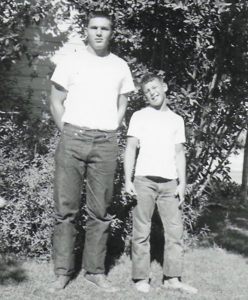
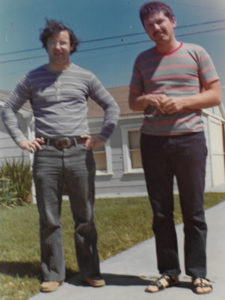
The author and his older brother

FQ: This, in a way, is a memoir. Can you tell readers a bit about your brother’s situation and how this book became an “idea” in your mind as a path to take?
JONES: My half brother and I grew up together. We had the same mother but different fathers. We lived with our mother in a small agricultural town in Northern California. My brother was 8 years older. We were extremely close. He became an attorney working at his father’s firm in Sacramento. I was in graduate school pursuing an academic career when he died. This was all worked into the book.
My father died 3 years before my brother and my half sister 1 year before my brother. My sister and brother were not related. I shared a father with my sister and a mother with my brother. A lot of terrible things happened to me more or less all at once including the stress of pursuing a PhD. I was heartbroken by the loss of my family. I left the academic world, moved to Mendocino, and went into the restaurant business. Years went by-marriage, children, grandchildren. The novel started brewing years ago. I wrote a few poems and stories setting down my thoughts. By the time I got around to writing the novel, I had a lifetime of experience that informed and enriched what I was able to write. So, in some ways the wait was worth it.
FQ: When it comes to your cast, were these characters in Mexico based on real people? If so, can you speak about the ‘spiritualism’ process that they personally have. Or, if these characters were fictional from your creative process alone, can you explain to readers about the shaman and the belief process they follow for healing?
JONES: I’m a Mexicophile, always have been. In the book Eric learns Spanish from a friend’s mother while in grade school. That was actually me in real life. I’ve traveled through and read extensively about Mexico. I have lots of friends there. The book has a long list of characters all meaningful to me. They’re drawn in part from actual experiences but mostly entirely fictional. I used real names but not real lives. Itandehui, my curandera, is the name of a young girl and her aunt. When I told them I used their name for my curandera they laughed: “We’re as far away from that as you can imagine.” I know very little about shamans and curanderas but witnessed a few such activities in my travels. I also read quite a lot about traditional healing methods. You may not be old enough to remember the Dragnet TV show. That show always started with “Ladies and gentlemen: the story you are about to hear is true. Only the names have been changed to protect the innocent.” In my case many of the names are the real names of friends but the stories and characters are complete fictions. I did do a fair amount of research on the Kumeyaay Indians of Southern California and I used some of what I learned in an altered form. Oddly, while I’ve been all over Mexico, I’ve never been to Tijuana where much of the story takes place. I carefully studied everything I could find about Laetrile. Some of the characters were based on that. Nothing was based on my brother’s legal cases. I’m not spiritual or religious at all. I was raised Catholic. That comes out in the book but I gave up organized religion long ago. One important character, Hector, was influenced by a William Castle movie, Mr. Sardonicus. The book was inspired by many other writers. The most important are mentioned in the Acknowledgements. The Stanford Medical Center Riot was a real historical event as was the Senate hearing on laetrile but all the characters were fictional.
FQ: Was the hard-boiled crime plot pulled from any of your brother’s cases, or did this come from your own personal passion to write this type of genre?
JONES: The hard-boiled crime plot was fictional. I based it in part on the research I did on laetrile. If you read the literature on laetrile, it’s populated with many nefarious characters. I created Krump, Napier, Zacco and Congressman Shipley out of that research. The Catholic priest was based on a real priest whom I read about. Louie Frieze, the curmudgeonly chemist, was a pure fiction I dreamed up one night when I wrote in a frenzy almost word for word as he appears in the book. Marcos was also fiction and also appeared unedited nearly intact. Likewise Penalt. I really love my characters. I still think of them all the time.

The author and his older brother

FQ: What are your views in regards to the ‘scientific’ part of medicine versus the ‘spiritual’? Do you believe healing could go further if people would expand their own minds to accept things they may not understand?
JONES: I’m more or less with my character Napier on that (i.e scientific) but not as heartless or plotting. I don’t believe in Naguals but I wish I did. What I know about them I learned in Oaxaca from the Zapotec artists that make the painted wooden animals, wool rugs, and the ancient stone temples; also the Huichol artists that live in Jalisco and Nayarit. Whether or not healing could go further if people would expand their own minds to accept things they may not understand I don’t know. But they should expand them anyway. That’s what makes life worthwhile.
FQ: Could you speak a bit to our readers about your Think in the Morning blogsite?
JONES: I set up Think in the Morning five years ago when I retired from financial advising. It was first a place to write about and document my days at the Sea Gull Restaurant in Mendocino, a popular gathering place in the 70s and 80s. One part of the blog is a virtual gallery of napkin art (art on cocktail napkins produced by bar patrons mostly local artists when they visited the bar). Later the blog evolved into a place to gather my thoughts on various subjects. More recently it’s been a place where I introduced my novel. On occasion I put up guest posts from friends, even a few from my grandkids. I now have 5 years and nearly 400 posts.
FQ: What would you say was the most fun part of the writing process, and the most difficult aspect of it when you look back on the book’s creation?
JONES: Creating the characters and allowing them to live was by far the most fun. They still live in my mind where they were created. One author/philosopher I’ve read and enjoyed is Miguel de Unamuno. In his novel Mist (Niebla or Fog) one character carries on a discussion with the author. It was the first time this technique was used I think. I have had many such discussions, very enjoyable. The hardest part was to follow through each scene to the end. I lack patience and usually cut things short only to realize or be told that I need to do more. Dialogue was hard, I’d never done it before and my first attempts were embarrassing. A sense of accomplishment was my reward, witnessing thought made real.
FQ: Do you have a specific genre that you’re interested in reading? Along those same lines, is there a genre you would like to write a book for in the future?
JONES: I have pretty wide interests. Good fiction of course but also biography, history, science and even economics. I have a number of short stories in various states of completion that I’d like to tighten up and maybe share in another book. I also have an idea for a short novel about a young girl (about 4 or 5) I saw on a bus in northern Scotland when I was in my late twenties. I only saw her once but her face stayed with me. I’ve imagined over the years what her life might have been like and how it might have changed under certain circumstances. I think about it a lot. I will leave details to the book if I ever write it. I enjoy writing immensely and hope to continue as long as I’m mentally and physically able.
FQ: What would you like readers and future writers to know about your journey through writing/publishing Behind the Locked Door? And what comes next?
JONES: I answered some of that in the question above. As for future writers I’d say if you really want to write, then do it. Don’t be afraid to ask other competent writers for help. I did and could not have finished without that help. It’s expensive to publish a book, and for me it took a long time, not a great source of income in most cases. But, it’s good to help you “go further” and to “expand your own mind” and to “accept things” you “may not understand.” That was the case for me anyway and I’m very happy I stuck with it.

#BookReview - Say Goodbye and Goodnight @DavidRuggerio

Say Goodbye and Goodnight

By: David Ruggerio
Publisher: Black Rose Writing
Publication Date: June 2020
ISBN: 978-1-68433-493-3
Reviewed by: Amy Lignor
Review Date: March 2020
Although not on shelves until June, Say Goodbye and Goodnight should most definitely get your motor running when it comes to a memorable, brash, romantic, intelligent, and very “cool” book that will easily garner rave reviews from anyone who takes the time to sit, read, and enjoy!
As if taking West Side Story and combining it with Rocky, then adding in a romance of young lovers that rival that of Shakespeare’s famous tragic couple, this story covers all emotions. When we first meet up with Anthony Marino (AKA: “Ant”) we find ourselves roaming the streets of Brooklyn, NY, in 1977. Yes, there are discos, electric music, and the Italian neighborhood of Bensonhurst that sticks together and fights for one another no matter what. There’s even a club that sits atop a car dealership aptly named, Romeo & Juliet’s. 
At 16 years of age, Ant is an integral part of this area which is, as the author states, filled with Italians whose ancestors came from the boot of Italy, as well as the “prideful people” who emigrated from Sicily—meaning you were either a housewife or a stonemason. Anthony, however, is a fighter. He is working to become that one star who deserves to beat the champ. His older brother, Sal, actually has a secret he only told Ant in order to keep it away from their father. Apparently, Sal has joined the police force instead of continuing the family line of stonemasons; this is wrong because the eldest son is expected to follow in his father’s footsteps. 
That’s not the only curveball thrown at Anthony. He also lives a life that includes men high up in the Mob who he shows respect to, yet is a bit nervous that one day he will have to work for because of the close-knit family tree and the sense of duty that’s prominent in his culture. He speaks about the monthly casino run out of a warehouse, and the wiseguys who are in charge. Even though Ant likes the idea of an easy life, he is determined to be like his hardworking father who did back-breaking work in order to raise and protect the family.
When not at school, Ant practices under the tutelage of Izzy Moischel, a Jewish fighter who made his name during the Great Depression. Izzy turns boys into true pugilists at his Youth Center, which brings pride to the community. It is here where Ant first sees Gia. She walks in, takes a seat with her friends, and he immediately becomes electrified by her presence. (The author uses stunning language for this first meeting by describing Gia’s beauty as being so great that “the pallet God used to create her made Michelangelo shed a tear.”) While Gia and Ant fit together in their minds and hearts, for others they are as opposite as night and day. Jealousy and anger are thrown at them that would make normal humans walk away from the relationship. But for these two, they own that epic love that will supposedly protect them from prejudices and people who refuse to open their minds to a different culture.
On top of all this is the hunt for the .44 Caliber Killer who is harming young women in other neighborhoods. A man Ant and his friends wish to stop before he can bring tragedy down upon their heads. 
You will find a smile on your face as the author uses 70’s terminology. From talking about ‘wicked storm troopers and adorable droids who took us on a whimsical journey to galaxies far, far away,’ to speaking about Elvis and how the ‘King was laid to rest but his music still reigned supreme,’ the writer draws the reader in, sets up the surroundings to exactly match that era, and tells his tale perfectly. 
The addition of hand drawings in this book are incredible, as well. In the end, the lessons learned in regards to what a “good” life really is, and the romance of Ant and Gia, make this book a riveting read that causes you to stay up late in order to see what happens next. 
Quill says: A book that is truly appealing no matter what genre you prefer. Ant and his world are something this reader will never forget. 
For more information on Say Goodbye and Goodnight, please visit the author's website at: www.ruggeriobooks.com