Tuesday, December 24, 2019

#AuthorInterview with Michael A. Brown @WITMFirst

Today, Feathered Quill reviewer Holly Connors is talking with Michael A. Brown, author of What I Tell Myself FIRST: Children's Real-World Affirmations of Self Esteem.
FQ: What was the impetus for writing What I Tell Myself FIRST? Why this book/this topic? 
BROWN: I am not an author by trade. I became one by trauma. I am the product of child abuse. The reasons? I still couldn’t tell you what I had done to earn physical chastisement. Usually, children remember some of the things they did to earn punishment. I don’t. I then began to hate my mother. I never understood, as most children don’t, why a mother who is supposed to be your guardian would physically chastise me like she did. I then began to run away into the arms of my grandmother.
Growing up, I would move between my mother’s and grandmother’s homes from time to time. In both homes, my brother, sister, uncle, and I went to various churches. As time passed, my mother inherited property as a result of my great-grandmother’s death. My mother appeared to have been fascinated with the church, as is the tradition among African Americans to have either been born into Christianity and attend church or seek Christianity, its assistance, and fellowship in a time of need. A building plan was finalized and donations were being solicited from the church members to erect it.
My mother, believing bigger giving equaled bigger and faster lottery-like blessings, refinanced her inherited property, being our residence. She then donated over 85% (approximately $30,000) of the finances from the loan to the church. The building would never be built. Her donation and neglect of the duties for which the funds were acquired resulted in foreclosure of the property and us being in a homeless state, with mother never to question the disposition of the donation or demand its return. Why did a mother with children do such a thing? The need for assistance and association in time of need, I would later learn, is the doorway by which some self-proclaimed pastors capitalize on those in said state to acquire, among other things, monetary donations while delivering spiritual stimulation as the payback. Mother gave all selflessly for the promise of earthly riches that would never come. She passed in 2018.
Fast-forwarding to late 2019, I was helping an anger management client with issues related to her anger. In doing so, I learned that a great percentage of anger happens when childhood voids, created by broken parents, are imparted in children thereby continuing to reside in now-anatomically/statutorily mature adults. These voids are the motivations for the often ill-prepared or toxic choices we make as adults. This would be the revelation I would learn in the wake of mother’s passing: those who seek to use you will spot your voids and capitalize on them for their own gain. I then could not continue to hate my mother for the pain she caused, for I now knew the motivation which influenced her choices. She was broken. As a result, I became broken. I then loved her again. I understood her. I then set out to find solutions to change what parents don’t do and what children don’t know: how to address the real world and prepare for the inevitable to achieve self-actualization. I always heard of affirmations. Plenty of books have them, usually filled with “I am” this and that. But they leave out the real-world attacks that parents know are coming. They hide the truth from our children.
FQ: You’re obviously a very devoted father (a quick look at your website makes that very obvious). Were you/are you worried about what your children were being exposed to in the “real world”? 
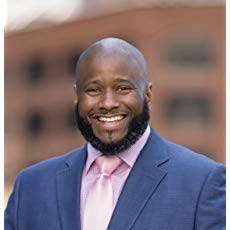
Author Michael A. Brown
BROWN: Worried is the reason I am undertaking this task, not just for my children, but for the world’s children with whom my children may contact. When we try to save face to our children, they often repeat what they see us do. In an attempt to remain their friend, some, if not most, parents do not discipline (mentally) their children, for their children are their security blanket to fill the Security and Love/Belonging stages of Maslow. Exposing our past mistakes and our motives, along with verbalizing and applying the principles taught in What I Tell Myself FIRST will assist in saving our children from a past.
FQ: You have done school readings of your book and judging by the pictures, the kids are really enthused about your book/your energy. How fun is it to share your message with schoolchildren? 
BROWN: Where do I begin? Absolutely fun and sad with different locations. I am and will likely be overjoyed with well over 97% of the places I have and will have visited. The children's curiosity is great for, according to Arnold Edinborough, "Curiosity is the very basis of education and if you tell me that curiosity killed the cat, I say only the cat died nobly." One should be noble in their quest for knowledge. I am a rather animated teacher. So, we are all having fun when I present. I love reaching their hearts and minds. Some of them bring me to tears, happily. Their responses and truth are so refreshing. This is actually therapeutic for me. However, you can actually tell the children who are suffering from pain at home. They don’t participate. No poker faces. They don’t believe what is being said. Children have yet to develop filters. It is rather easy to see their non-participation as a likely indicator. It is furthermore sad to say that some daycares are NOT teaching the children anything. They are just babysitters being taught by televisions. In some, the discipline is lacking for story time.
FQ: You base your book on “Maslow’s Hierarchy of Needs.” Would you tell our readers a bit about Maslow and his beliefs? 
BROWN: Maslow’s Hierarchy of Needs is a psychological theory of motivation created by psychologist Abraham Maslow that itemizes the needs that we, as humans, need in order to self-actualize into our best self. There are five levels. Physiological (Breathing, Food, Water, Excretion, Homeostasis, Procreative Sex), Safety (of Body, of Resources, of Money, of Family, of Employment), Love/Belonging (Family, Friendship, Sexual Intimacy), Esteem (Confidence, Respect for Self/Others), and Self-Actualization (Creativity, Lack of Prejudice, Acceptance of Facts, Morality, Spontaneity). The principal theory is diagrammed in a pyramid with the most important needs (Physiological) being placed at the bottom. If the need is not met, we become fixed at that need until the need is met. This fixation in the stage of need creates the motivation for fulfillment. The duration of the void and the importance of fulfillment becomes the exigency toward the void that either the void or we, because of the void, create. How we fulfill that void depends on how we have learned to care for oneself. Thus, the toxic decision-making is the result of never having been taught to positively survive and deal with negativity. Toxic decisions are then made for the actor is likely unaware that the decision is in fact toxic.
FQ: Lots of children’s books focus on building self-esteem but I don’t see many that also teach self-reliance and self-responsibility. Indeed, in today’s culture, it seems to be the “in thing” to blame others for your problems. What would you tell people who blame their parents, teachers, strangers, etc. for their problems? 
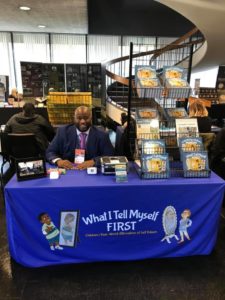
Author Michael A. Brown at a book signing
BROWN: I understand the subjective necessity to blame others. It’s a defense mechanism and a deflection. I’m not easily moved by it. Getting tied down with debating the blame-shift take time that is precious and can’t be returned. I move past it and urge they do the same. I’m a military veteran. I was also in high school Army JROTC. I didn’t tolerate excuses as a teen commander of cadets. If they want to get out of the mess they are in, they will show me by action and a willingness to commit to the principles of self-esteem establishment. Everything in one’s life rises and falls on the leader’s leadership, especially of the self. As leadership guru, John C. Maxwell says, “...lead yourself exceptionally well.” Leadership by action. I usually have them point the finger outward toward the thing to be blamed. Then, have then focus on the three fingers curled inward toward the pointer. Then, I ask them to give me three solutions to their own problems.
FQ: In your book, you tell readers that “It is NO ONE’S job to Make Me/Heal Me/Protect Me from anything. That is my job.” I love this message but I suspect some people (those of the blame others culture) might disapprove. Have you gotten any pushback from such people? If so, what do you tell them? 
BROWN: Funny that I answer this question in the wake of my Kirkus Review (Dec. 2019) of What I Tell Myself FIRST that actually said “... some of its statements are questionable, such as “It is NO ONE’s job to ‘Protect Me’ from anything. That is my job.” Many would say that adults should, for example, respond to bullying.” Talk about pushback, right? Nevertheless, it is evermore imperative that readers understand, and most such as yourself do, that I am not negating parental responsibility to address bullying.
But, to that pushback, which I not too often get, I would dispatch the often-deflective pushback with the question, “If parents had been addressing the issue, what became the need to make October National Bullying Prevention Month in 2006 and as such, extended in 2010?” They usually have no answer. The lack of prevention is the impetus. Bullying is the likely result of children shadowing their pain through various outwardly-displayed verbal, psychological, and physical methods toward targeted persons displaying outward defensive weaknesses.
The bully, like the bullied, is likely suffering some similar or worse problems at the mecca: the home. Broken parents are more likely too busy operating in reverse working to create the finances they should have had prior to child acquisition, likened to hiring employees without funds for payroll. Doing this while continuously residing in the void that spawned their current status, they haven't the time to teach their offspring/employees/children how to protect themselves. The parent often can't protect themselves or stay away from that which is harming them because of the void. One way to break away is for the parent to eliminate excuses and begin empowering their children to do for self early on by reading to them What I Tell Myself FIRST daily. Its real-world affirmations highlight the various abilities and attributes of the reader while exposing readers to realistic possibilities of rejection of difference in various forms. What I Tell Myself FIRST enables readers to form mental frameworks to surmount those forms of rejection and achieve positive self-actualization.
FQ: You’ve served in the military and as a police officer (thank you for your service!). How has your time in these professions changed how you view what’s going on in today’s world? 
BROWN: I greatly thank you for your compliments and support of the forces which guard our freedom and way of life. The lack of discipline is present in our nation. I have seen a lot of ugly in both professions. Conflict and the worst of the worst are what we are trained to address. I miss the pledge of allegiance. I miss when being American was cool and it has changed how we approach the future. We’ve let the kids take the house in the names of varying agendas.
FQ: As a police officer, did you see kids get into trouble where self-esteem was a definite issue/cause of their problems? 
BROWN: Yes. Kids with behavioral and self-esteem issues can typically be the display of the pain embedded into them by their broken parents, knowingly and unknowingly, who either hide the truth of the reason for the child’s existence (saving a failing relationship, monetary reasons, seeking a Maslowean friend/security blanket, etc.). The lack of self-esteem is the result. The behavior is the display. The cause is typically the parent. I am a detective by training and profession. When I dig, I usually discover that.
FQ: You mention in your note at the end of the book that you’ve learned a great many lessons throughout your life and your various careers. Is there a lesson that you couldn’t fit into the book that you’d like to share with our readers now? 
BROWN: Sure. Parents, don’t lie to your child. Parents who do this are concerned with how they look in the eyes of their child. The lying parent sees the child as their friend, not their child. You can’t protect your child from a void you haven’t protected yourself from. Your experience is the master class. You are the master teacher. Expose your past to save them from a past and yourself from a future occurrence. Ask any doctor. There must be some infliction of pain in medical operations to cause healing. Not every pain can be numbed. Even numbed, when you wake up in recovery, you will feel it. Pain precedes most healings and recoveries. What you reveal may hurt your children. But the lessons you will have taught them from the revelation, likened to the rung bell that can be un-rang, will be etched in their mind when you are no longer around and that lesson appears at their feet. They can’t dodge the bullet you neither told them was coming, nor bulletproofed their mind towards repellency and rebounding.
FQ: With the success of your first book, have you decided to undertake another writing project? If so, would you give our readers a peek at what you’re working on/will be working on in the near future? 
BROWN: Oh, yes. What I Tell Myself is a series. FIRST is the foundation upon which the other books will be written. I will keep expounding on Maslow, for educators know all too well, “In teaching, you can’t do the Bloom (Bloom’s Taxonomy) stuff until they do the Maslow stuff.” - Alan E. Beck. Individual characters have names and adventures that will be Maslow-focused. I have already penned two books currently in editing and illustration. The titles are What I Tell Myself: About Self-Protection and What I Tell Myself: About Talent. 
What I Tell Myself: About Self-Protection gives children various options for protecting themselves. It is powerful. I read it and feel empowered! I raise my children not to be victims. I want my readers, both parent and child(ren), to avoid victimization. I like active books that give solutions. I want my books to be roadmaps for action. In life, actions get things going. Let’s cry silently along the way. But, get off the “X”. I guess that is the military/police officer in me.
What I Tell Myself: About Talent explores the inquisitive mind of a child who wants to be everything and anything at the same time. Keeping with the page in What I Tell Myself FIRST, “I am great at some things...” a child told me he didn’t know what he liked to do. Lightbulb. Stay tuned.

Friday, December 20, 2019

#BookReview - Body in the Woods @bhctkaya

Body in the Woods: A Jack Ludefance Novel
By: Behcet Kaya
Publisher: Amazon Digital Services
Publication Date: September 2019
ISBN: 978-1694592125
Reviewed by: Lynette Latzko
Review Date: December 20, 2019
Behcet Kaya, author of Treacherous Estate, returns once again with another thrilling installment in the PI Jack Ludefance series with his latest, Body in the Woods.
Body in the Woods has a tense, atmospheric beginning that starts with a body. The body is that of Heinrich Hines, discovered by a woman on her daily trail ride with her horse in the woods of Southern California. Readers quickly discover that Mr. Hines was an extremely intelligent, and often abrasive, scientist who had access to a complex, powerful formula that once placed on the body of an aircraft, made it completely undetectable to radar or satellites. He was in the process of what he referred to as “a deal of a lifetime” with one of five countries, and their government heads, in attempts to sell the formula to the highest bidder. Unfortunately for Heinrich, he was unable to complete his mission, and worse yet, investigators only had one possible flimsy lead into the identity of his killer. His business partner, Vance McGruder, was overheard arguing with, and threatening to kill Heinrich a few days before his body was discovered in the woods, and was now the prime suspect. But did McGruder try to foil Heinrich’s plans by murdering him, or was there someone else involved? 
To hopefully not only discover the identity of the murderer, but more importantly to clear his name, wealthy businessman Vance McGruder hires Private Investigator and friend, Jack Ludefance. Without a moment of hesitation, Ludefance flies out from his home in Florida to Los Angeles where McGruder resides, and starts what becomes a tricky and difficult investigation involving political maneuverings from several countries all vying for the chance of getting their hands on the invisibility technology. 
Although Body in the Woods is the second time PI Ludefance stars in a gripping thriller, readers will be able to quickly delve into, devour and enjoy every aspect of this story without any confusion about the events in his past novels. This is because author Kaya’s writing and character development is just as strong in this book as in his first installment. Readers easily become attached to the “realness” of this private investigator and not only become engrossed in the storyline, but will quickly want to root for him to ultimately discover who’s the real killer behind the Hines murder. There are also other characters throughout this story that help to enhance the overall reading enjoyment, including Rudy, the malodorous computer hacker hired by Jack who’s quite adept at pulling data out of Hines’ computer and other pertinent information, and Mariana, the lovely housekeeper at Heinrich’s home who has a shocking secret of her own to reveal as the story progresses. Body in the Woods should not be missed. Even the most seasoned fan of the thriller genre will be shocked at the intricate and twisty ending. 
Quill says: Body in the Woods is an exciting, fast-paced read for mystery/thriller readers and PI Ludefance fans alike that will capture your attention, and hold it tight until the surprising conclusion.
For more information on Body in the Woods: A Jack Ludefance Novel, please visit the website: www.hollywoodturk.com

Tuesday, December 17, 2019

#BookReview - Cooperative Lives @pat_finegan

Cooperative Lives

By: Patrick Finegan
Publisher: Two Skates Publishing
Publication Date: March 2019
ISBN: 978-1090893639
Reviewed by: Anita Lock
Date: December 17, 2019
Irony sets in with a New York cooperative apartment dwelling when one act of goodwill evolves into an “everything sinister” change of events in Patrick Finegan’s debut, Cooperative Lives.
Jack Roberts has more than his fair share of problems. If finding himself unemployed after having worked for three different offices—all of which go belly up—wasn’t enough, he now has to care for his wife Susan, who uses a wheelchair as a result of a skiing accident. Fortunately, Melissa, their teenaged daughter, keeps him active with school and her extracurricular figure skating lessons.
While out as a family, walking about the city, life for the Roberts takes an unexpected turn when Sheldon Vogel, a widower and tenant in the same apartment complex, saves Susan from getting hit by a bus. What Jack doesn’t know is that a chain of events from Sheldon’s sacrificial act will unfold into nothing less than a nightmare. Whether or not Jack and his family come out unscathed remains to be seen.
Patrick Finegan pens a riveting and unnerving mystery in his debut, Cooperative Lives.The lawyer and financial consultant turned rising author knows a thing or two about life in New York City, having lived and worked there for thirty-plus years. Finegan succinctly captures the essence of the country's most populated megacity, and not just the sights, sounds, and smells. What is so unique about his plot is the way he capitalizes on New Yorkers’ quirks—lack of eye contact, always on the go (especially with the crazy traffic), and small talk—amid a host of elusive characters.
Finegan’s forty-plus cast that ranges from innocent to mainly shifty co-op residents, doctors, lawyers, and beyond, is as multilayered as his plot. A good example is George Wallace (Wally), who is one of the tenants and is a devoted husband and father. He’s also a topnotch hacker. Another is co-op tenant Mildred Whiting Blaszczyk, who not only wants to be acclaimed as a rising romance author but also thinks nothing of having the maid dust her taxidermic dog.
Divided into four sections, Cooperative Lives keeps to third-person POV while shifting cast members between the present (2012-2013) and the past (backstories and subplots), which then provide glimpses into the nitty-gritty of prominent and supporting characters, while at the same time slowly building tension. Finegan skillfully takes all of these literary elements to create unanticipated conflict, resolution, and a startling ending.
Quill says: A page-turner from beginning to end, Cooperative Lives is a must for mystery aficionados.
For more information on Cooperative Lives, please visit the publisher's website at: www.twoskates.com/cooperative-lives

#BookReview - What I Tell Myself FIRST @WITMFIrst

What I Tell Myself FIRST: Children's Real-World Affirmations of Self Esteem
By: Michael A. Brown
Illustrated by: Zoe Ranucci
Publisher: Mabma Enterprises, LLC
Publication Date: November 2019
ISBN: 978-1734184808
Reviewed by: Holly Connors
Review Date: December 15, 2019
Debut author Michael A. Brown has written an uplifting children's book, full of positive messages that will empower children and teach them to better handle what life may throw their way.
The first page of What I Tell Myself FIRST asks the reader to write their name on the page (line provided) and then tells the reader, "I am alive, alert, and able. (Take a Deep Breath. Now exhale. Don't hold your breath, silly.)" and the mood is now set for a fun, very positive, self-esteem building book. Continuing with the interactive theme, the next two pages ask the reader to write down what they think "The truth is (what do you think the truth is?)," and "A lie is (what do you think a lie is?)." Each of these two pages has suggestions/examples to assist the reader with coming up with an answer. On the "lies" page suggestions include "I will never be pretty..." How often have parents heard that from their child?
The rest of the book teaches simple, positive messages that work toward teaching every child that "I Like Me!" The first message readers find is:
"I must love me FIRST.
I must be selfish before I am selfless.
I am no good to anyone else, if I am not good to myself.
I must do for myself, first. I must protect myself, first."
Unlike many books that give kids an unrealistic message that they are wonderful at everything, and that they can do anything, What I Tell Myself FIRST gives kids a real-world message that "I am great at some things. I am good at other things. I am not good at some things," but that's okay and the author tells his audience why. The book also tells readers such important things as thinking before talking, listen to others to understand, and how to speak with respect.
Each page has one (or on a few pages, two) topics of importance. The topic, such as "Work equals worth" is in a larger font, and the text is bold so that it stands out. Following that text is one or two lines of further explanation in a smaller, but still easy to read font. This allows young readers to quickly identify the topic. For example, one page shows four young friends playing basketball with the line "My body is what it is." Below that text is the explanation, "Skinny, Fat, or Short with a Hat. Tall, Small, Basketball!" 
I wasn't sure what to expect when I received What I Tell Myself FIRST for review. I've read/reviewed a lot of books aimed at children with the goal of teaching them how to handle difficult situations such as bullying. Some of them just aren't realistic in their suggestions. What I liked so much about this book is that it tells kids that before they can solve other problems/issues, they must first love themselves. It also says that they may not be the best, prettiest, strongest, etc., but that that's okay. As long as "I am beautiful/handsome TO ME" it's okay. What a great message! I also really enjoyed the illustrations that are bright, playful and the children in every picture truly look engaged and as though they are having fun. 
Quill says: What I Tell Myself FIRST is an excellent book that should be in every classroom and shared with young readers from preschoolers through elementary level readers. The positive, self-affirmations it teaches are priceless.
For more information on What I Tell Myself FIRST: Children's Real-World Affirmations of Self Esteem, please visit the book's website at: www.WhatITellMyselfFIRST.com

Thursday, December 12, 2019

#AuthorInterview with Kaylin McFarren @4kaylin

Today, Feathered Quill reviewer Lynette Latzko is talking with Kaylin McFarren, author of High Flying.
FQ: The main character in your novel High Flying is a young, female stunt pilot. What was your motivation behind creating a character with such a unique job?
MCFARREN: I virtually grew up with United Airlines, since my father was the lead maintenance foreman in L.A. in the late 50s, and later in Seattle. I remember sitting on his shoulders, watching planes take off on the tarmac and dreamed of becoming a pilot one day. It wasn’t in my cards, unfortunately, but I always enjoyed going to airshows, watching stunt pilots accomplish amazing feats. I wanted to create a daring female pilot willing to do anything to overcome her fears and troubled past.
FQ: At the beginning of each chapter in your book, you open with a quotation by an anonymous author. Is there any personal significance in your choice of quotes?
MCFARREN: I wanted each quote to reflect the actions taking place in each chapter and to pick anonymous lines that anyone could relate to —female and male alike. In other words, they’re kind of an introduction of what’s to come.
FQ: Back to your main character, Skylar Haines, who is described as a person who self-harms. What led you to create a character with this particular issue, and what type of information did you come across when doing research on this topic?
MCFARREN: I wanted to created a story about a badly damaged soul, pushed her to her limits, and ultimately leave her believing that she had value, redeeming qualities and skills that she wasn’t even aware of until the final pages of the story. This tends to be my MO with stories — allowing my characters to grow and surpass their mental and physical limitations. We all need a hero, but also a believable role model that gives us hope.
FQ: Are any of the characters from High Flying based on real people?
Author Kaylin McFarrenAuthor Kaylin McFarren

MCFARREN: Every character in High Flying was based on people I’ve met in my life. Some are daring, others are afraid to take risks. But they all are interesting, three-dimensional beings with a passion for making their marks in this world.
FQ: Time travel and having the chance to possibly influence one's past is one of the themes in your story. If you were given an opportunity to go back in time and possibly make an impact on events in the past, would you? 
MCFARREN: Knowing what I do now, I definitely would. One example: my father died from colon cancer because he never considered having himself checked. He’d still be alive if he had. My oldest brother rushed to enlist in the military to fight in the Vietnam War because he wanted to be a hero, never knowing that exposure to Agent Orange would ultimately kill him. There are so many "what-ifs" that I’m sure we’ve all faced at one time or another in our lives.
FQ: What do you hope readers will take away from reading your novel?
MCFARREN: To not be afraid to take risks or consider all the options when faced with the worse possible situations. We need to strive to rise above the cruelty and hardships in our lives and not let them deter us from our hopes and dreams.
FQ: I see that you are a seasoned writer, including having written a four-book series. What advice do you have for new authors just beginning their writing journey?
MCFARREN: Stay true to your passion and don’t let anyone’s opinions or hurtful comments keep your from realizing the goals you set forth for yourself.
FQ: Are you currently working on any new writing projects?
MCFARREN: Yes. A new Sci-fi thriller that keeps me up late at night, typing away. I love delving into all kinds of genres and creating an interesting cast of characters that readers will relate to and hopefully root for as well.
FQ: Is there anything else you would like readers to know about you? 
MCFARREN: I guess that I’m like most writers, longing for an expanding band of cheerleaders that enjoy every story and far-fetched tale that cultivates in my mind and finds it’s way onto a shelf. In one way or another, we all want a slice of immortality even if it comes on a written page. 

Tuesday, December 10, 2019

#BookReview - Self-Styled

Self-Styled: Chasing Dr. Robert Vernon Spears

By: Alan C. Logan
Publisher: Glass Spider Publishing
Publication Date: November 2019
ISBN: 978-0-578-55834-9
Reviewed by Diane Lunsford
Review Date: December 9, 2019
In his latest book, Self-Styled: Chasing Dr. Robert Vernon Spears, Alan C. Logan chronicles the life and times of one of the most notorious confidence men, Dr. Robert Vernon Spears.
Who would have thought that the crash of Flight 967 on November 16, 1959 would be the beginning of the end of the road for Dr. Robert Vernon Spears? In breaking news of the crash, Spears was reportedly on this flight. When his newly widowed wife, Frances, learns of the crash, to compound her grief, she will have to break the news to their two young children. Not so fast. It seems there is a woman, Alice Steele, in Tampa, Florida who has a few things to say about this latest course of events. She is the ex-wife of Spears’ life-long friend and confident, William Allen ‘Al’ Taylor, and at the same time the plane has gone down, so has the disappearance of her former husband risen to the surface. Is it possible the two are connected?
Never overly fond of Frances and certainly Dr. Spears, Alice Steele makes it her mission to get to the bottom of this mystery. She’s certain the two are connected and by cracky, she’s going to persist with the assistance of the press to get what she believes to be the real story out there. It’s important to note that Alice, Frances and an entire assortment of con artists ranging from law enforcement, judges, attorneys and patients will have their side of the story before the real story has a beacon of light shone on it once and for all.
Alan Logan has spun an outstanding body of work in Self-Styled. There are countless twists and turns that are fine-tuned and precisely placed throughout this read. He is a master at planting seeds to germinate before he moves on to the next turn of events. Only when those previous seeds have blossomed, does he cultivate them into the growing plot of the complexities of the multi-faceted dynamics of the quintessential conman of the century, Dr. Robert Vernon Spears. This was a fascinating read because Mr. Logan has done a superb job of spoon-feeding his audience with just the right amount of information that took little effort for the reader to turn the page and consider the next diabolical set of twists and turns con artist Spears was capable of delivering. In my opinion, this story would bode well as a mini-series in today’s culture because there are far too many plot twists for a two-hour movie to do the story justice. Fascinating read and admirable delivery Mr. Logan! 
Quill says: Self-Styled is a page-turning, fire-breathing, fascinating account of undoubtedly one of the most infamous conmen in our history.
For more information on Self-Styled: Chasing Dr. Robert Vernon Spears, please visit the author's website at www.chasingspears.com

#BookReview - Chicago Rink Rats

Chicago Rink Rats: The Roller Capital in Its Heyday

By: Tom Russo
Publisher: History Press
Publication Date: November 2017
ISBN: 978-1-6258-968-6
Reviewed by Diane Lunsford
Review Date: December 2019
Tom Russo delivers Chicago Rink Rats and takes his audience down a bittersweet memory lane of roller skating in its heyday.
The book opens with a forward written by Darius ‘D-Breeze’ Stroud, one of Chicago’s JB Elite Skate Team and Chicago’s Independence Roll members. Stroud reminisces growing up on roller skates in the 70s and how he continued to do so as an adult who specialized in ”Chicago-style JB skating.” To add color to his reflection, he notes that not only did the Savoy jazz band play at Al Capone’s Rainbow Room, but also entertained skaters at the Savoy Roller Rink. It was all about the music that created the nostalgia he and his companions related to skating whether it was ‘...organ music, the jazz bands of the 1940s or the rhythm-and-blues we skate to today...’
Moving on from the Forward, Russo reflects on his mother’s great-grandchildren and their wonder of just exactly what she did for fun growing up. Of course, there was no internet, computers, cellphones, etc. to occupy the mind from sunup to sundown. She’d smile her melancholy smile and wander back to the time when she and her ‘gang of girls’ would venture out to the roller rink. 
Getting into the meat of the book, Russo opens his first chapter, ‘The Golden Age of Roller Skating,’ and sites some statistics such as ‘...there were an estimated four thousand rinks and more than 17 million skaters. The wheels were wooden, roller skating was hip, everyone went to a rink and Chicago was the epicenter. The year was 1943, the world was at war and roller skating promoted itself as a wholesome, social form of recreation that provided relaxation for soldiers, sailors and war workers...’ Russo continues to span the decades from the 40s to the 70s and how the art, nuance and overall draw of the sport transcended not only in skate design, but rink design and the attraction and music as well.
This was an interesting read in that the only form of ‘roller skating’ I had ever done was when rollerblading became popular in the 1970s. To this day, I’ve never donned a pair of roller skates and it was fascinating to read Russo’s in-depth research on the entire sport, be it for recreation, competition and even the birth of the roller derby. There is a distinct tone of nostalgia complemented with history throughout this read. The flow is great as Russo strategically parses his knowledge out decade by decade to his audience to keep them engaged from beginning to end. This is a great read that can appeal to many genres because of its historical content and subject matter. Of special note is that Chicago Rink Rats won the first place/gold award in the historical category in the 2019 Feathered Quill Book Awards.
Quill says: Chicago Rink Rats is a wonderful opportunity to take a step back in time and embrace the innocence of such a time in our history.
For more information on Chicago Rink Rats: The Roller Capital in Its Heyday, please visit the author's website at www.hunt4cleanair.net