Friday, October 26, 2018

#BookReview - Boo!

Boo! A Chilling Tale of Too-Too #MeToo

By: Simon Plaster
Publisher: Mossik Press
Publication Date: September 7, 2018
ISBN: 978-0-9994-1851-2
Reviewed by: Amy Lignor
Review Date: October 25, 2018 
Let us begin with the fact that if you’re a fan of Halloween, this is one cover you are absolutely going to love. And that’s only the half of it, considering the story is fun, suspenseful, and stars a cast that many readers have already had the good fortune to meet and fall in love with. 
Her name is Henrietta. She’s a journalist who works for the OKC SCENE News Group, but one day wishes with all her heart to win a Pulitzer for far more serious stories. Alas, for now, she’s stuck reporting on the Oklahoma nightlife ‘scene’ that is most definitely not serious enough to get her recognized...yet.
This time around, we catch up with Henrietta at work, staring at a copy of her resume on the computer screen. Why is she ready to give up? Well, it seems that her new boss, Nigel Fleetwood, has turned into something she didn’t quite expect when he’d first introduced himself. (Or, as Henrietta says, “hisself.” You gotta love that accent!) Anyway, Nigel certainly seemed to know the newspaper business and, upon taking over, did announce that he was doing away with the zone editions that just focused on local nightlife. Instead, he wanted to print a single city-wide paper called SCENE that would also cover real news from around the world. 
Unfortunately, after appointing Henrietta Assistant Editor, this weekly paper was revealed as being something even worse than a tabloid. Nigel likes to “borrow” from other papers when it comes to stories for SCENE, and the stories he borrows are amazingly tacky. (Example: Launching SCENE with a post-Christmas edition, the borrowed headline read, “Get the Tart Who Used My Flu for a Loo!”) Henrietta is tired of all this and even more upset when Nigel shows her a recent ridiculous story regarding a haunting in HRH’s palace in London. He tells Henrietta to find a local story that would somehow fit the same premise of ghosts and sexual harassment taking place in a haunted palace.
We then meet up with Wynona Sue Lehough, Henrietta’s mother, who has had a slew of interesting marriages and divorces, to say the least. She’s had to deal with everything from cheating to sexual harassment, and is currently laying on a couch and speaking to her head doctor, Gloria Stern, about her latest issue. Turns out that a producer/director by the name of Deano DeBoffo came into her small town two years ago, having chosen Wynona’s salon, Hair House, to be the setting for the pilot of a reality TV series he was shooting. He had lied and broken her heart back then, and the situation had even caused her own “hotshot journalist” daughter to turn against her. Not only that, but the F.B.I. even arrested the man for murdering an actress with a poisoned spicy meatball at an Academy Award banquet.
Let us just say (not wanting to give too much away) that Deano DeBoffo is scheduled to return. However, even though his visit is on the down-low, there is a ton of gossip and anger as memories and information regarding his sexual harassment attacks rise to the surface. This mogul, nicknamed the “Weinkenstein monster,” will find himself linked up with The Haunted Castle – a run-down dinner theater with an infamous history and a ghostly vibe. (Sounds just like the “local slant” Henrietta was told to look for, doesn’t it?)
Victims of the Weinkenstein monster’s harassment, along with a psychic who will be utilized to call a ghost from the “other side” in order to testify on behalf of the accused, and many more, will all play a part in figuring out if Deano DeBoffo is truly a guilty fiend or an actual victim of a cold-hearted liar who aims to destroy him. 
With Henrietta covering the event at The Haunted Castle, it is amazing what unfolds as this author does, yet again, another outstanding job of telling a great mystery. He should also be commended for covering such a hot topic in today’s world as he introduces great characters and a fast-moving plot, while keeping the fantastic Henrietta at its core. 
Quill says: This is one series that no reader who loves sarcasm and suspense should miss!

#BookReview - The Tiny Tree

The Tiny Tree

By: Norman Whaler
Illustrated by: Hrytskova Polina
Publisher: Beneath Another Sky Books
Publication Date: December 2017
ISBN: 978-1948131117
Reviewed by: Holly Connors
Review Date: October 2018
A tiny, scraggly cypress tree finds herself surrounded by big, strong trees that make fun of her in Norman Whaler's The Tiny Tree. Will the little tree ever find acceptance?
On a lovely sunny day, a forest ranger walked into the woods with a watering can and a tiny cypress sapling. He found a perfect spot to plan the little tree, in a place near many big, beautiful trees. The forest ranger planted the tree, watered it, and then left to do other chores – it was now up to the cypress tree to grow big and strong. Unfortunately, the other tress had never seen a cypress tree and made fun of the little twig. 
Now, this young twig was different from the others.
She didn’t look like her tree sisters or tree brothers.
They all had beautiful and colourful leaves.
She instead had needles and big knobby knees.
The other trees told the little, scraggly cypress tree to leave their forest because she wasn’t like them. 
This made the tiny tree feel very, very sad,
For to be different must be very, very bad.
Time went by and the cypress tree grew big and strong, but still the other trees would not speak to her. Then one day, a terrible storm blew through the forest. The winds were so powerful that the big, strong trees were worried they’d be blown over. But the cypress tree had roots that went much deeper into the ground. She could withstand the strong winds – would she help the other trees survive the storm?
The Tiny Tree is a story that tackles the topics of being different and bullying in a story that children will easily understand. Without getting preachy, the author has written a story in a gentle rhyme that delivers a fun tale that also provides an important anti-bullying message. Young readers will see how the big trees’ bullying makes the little cypress tree feel, and realize it isn’t a nice thing to do. They’ll also see how being different can be a wonderful thing when everybody works together. The pictures are simple and bright, with all the trees sporting great expressions that easily show children what each is thinking. If you’re looking for a book for either the classroom or the home bookshelf that will teach children about bullying and how to handle feeling different from others, consider The Tiny Tree.
Quill says: A powerful lesson on fighting racism and bullying, that delivers its lesson wrapped in a lovely story of a little cypress tree.
For more information on The Tiny Tree, please visit the author's website at: www.normanwhaler.com.

#BookReveiw - Am I Black or Am I White?

Am I Black or Am I White?

By: Norman Whaler
Illustrated by: Jasmine Mills
Publisher: Beneath Another Sky Books
Publication Date: March 2018
ISBN: 978-1948131087
Reviewed by: Holly Connors
Review Date: October 2018
Tara is a beautiful young girl with a problem – she is the product of a biracial marriage and gets teased by both white and black children. What can she do?
Most of the children at Tara’s school were nice to her but it seemed that there was always somebody who wanted to tease her. “Are you Black or are you White?” they’d ask her as they laughed. Children can be so cruel to each other!
Most Black kids didn’t make a fuss.
And most White kids said, “Come, sit with us!”
But, some didn’t like her from the start,
That she was too light or she was too dark.
The teasing hurt Tara and she often found herself in fights at school with those who went out of their way to pick on the young girl. Those cruel children also mocked Tara's parents for marrying and expected her to pick one over the other. But how could she choose? She loved both her parents and the mix of cultures they gifted her with. Tara felt lost and cried to her mother. She needed her parents' help to decide “Am I Black or am I White?” Would Tara ever be able to find her place in the World?
Am I Black or Am I White? touches on a sensitive subject that is often overlooked – how the children of biracial marriages cope with the teasing they often receive from schoolmates. The book opens with a page honoring Martin Luther King, Jr., and is dedicated to Dr. Alveda King. There is also a page of Biblical quotes related to the story and a strong Christian message of love and acceptance throughout the tale. The book has a beautiful message of love and “...to be brave against the lies of hate.” Readers also learn that “Everyone should be proud of who they are, whether born here or come from afar.” It is nice to see a children's book tackling this difficult subject in a sensitive way and youngsters who have experienced hate will find comfort in this book.
Quill says: Am I Black or Am I White? bravely takes on a tough subject with love and understanding, helping to teach children how to deal with the teasing that biracial children frequently encounter.
For more information on Am I Black or Am I White?, please visit the author's website at: www.normanwhaler.com.

Tuesday, October 23, 2018

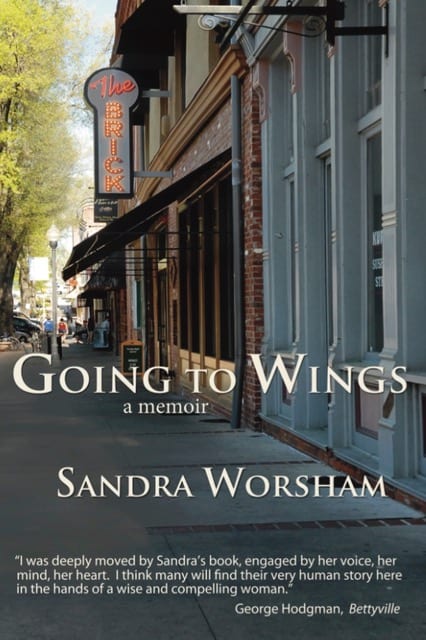
#BookReview - Going to Wings @seworsham1

Going to Wings

By: Sandra Worsham
Publisher: Third Lung Press
Publication Date: August 2017
ISBN: 9781548828106
Reviewed by: Anita Lock
Date: October 22, 2018
Sandra Worsham bares her soul in her moving memoir Going to Wings.
Worsham opens her debut in 1975, the year she earmarks “The Telling” when she reveals to her mother the extramarital affair she had in 1969 with not a man, but a woman—Ellen, a fellow teacher. The result is devastating. Her mother’s rejection compels her to cut off her relationship with Ellen and find a way to “fit in” regardless of her unrelenting attraction to females. Guilt-ridden, she determines to please her mother. Making her marriage work is her first order of business, but fitting into her wifely duties is easier said than done.
Two years after her stint with Ellen, Worsham meets Mary-Louise, a flamboyant church organist who is a woman twice her age. A Pygmalion relationship ensues. Worsham is a willing participant, committed to taking on a new identity via this teacher-student connection until rumors arise about her close ties to the worldly woman. More identify changes occur with Teeny, another fellow teacher, in 1975. Although their platonic relationship lasts for thirty years (2005), the last ten years are filled with unresolved conflict after the death of her mother (1995). With life appearing gloomier than ever, the last thing she expects—and in the most unexpected of circumstances—is true love.
Worsham covers a near fifty-year span of time in her page-turning memoir. Delicately covering the nuances of a heavily-laced patriarchal society in the heart of the Bible Belt, Worsham candidly lays out her past, voluntarily airing out her dirty laundry. What she spells out in her presentation is embarrassing, to be sure, but at the same time, not uncommon to anyone in the LGBTQ community who has struggled with issues of right and wrong, good and evil, and overcoming fear in various forms in the fight for truth and identity.
A captivating raconteur, Worsham fast forwards slightly before taking readers through a chronological journey riddled with pain and the hope for a better tomorrow. Her writing style is frank but not crass. Sections dealing with sex are straightforward but not explicit. Her human-interest stories flow—at least to this reviewer—like a Harper Lee novel.
Divided into four sections, Going to Wings provides readers with so much more than personal identity as Worsham explores spirituality and realities that come with losing loved ones.
Quill says: Going to Wings is a powerful must-read and a delightfully welcomed addition to the LQBTQ literary collection.
For more information on Going to Wings, please visit the author's website at: www.sworsham.com.

Friday, October 19, 2018

#AuthorInterview with Amiee Cabo Nikolov @godisthecure1

Today, Feathered Quill reviewer Diane Lunsford is talking with Aimee Cabo Nikolov, author of
Love is the Answer, God is the Cure.
FQ: I’ve often used the catch phrase: ‘You just can’t make this stuff up.’ I lost count of the number of times I reflected on this notion while reading Love is the Answer, God is the Cure.  When did you have your ‘moment’ and make the decision to write your memoir?
NIKOLOV: When I was 15 years old, being already through so much that a nurse at the psychiatric ward I was placed on told me I should write a book, I knew all these years I should write my book but it wasn’t until I played a video rosary through Facebook every day that I got the idea I should write it now, but it wasn’t until much later in time when I was 43 years old. And indeed a lot of different things have happened to me, I don’t even believe it now how I kept going.
FQ: I have a great love for both reading and writing. I find the art of writing to be extremely cathartic at times. Were there moments when you experienced the euphoria of healing when penning your memoir?
NIKOLOV: Yes, I felt proud of myself as U was able to let go as writing was really therapeutic for me. There were moments that were difficult to revisit as I had set aside memories for along time but even more rewarding as I revisited triumphant moments and graces received that changed my life.
FQ: In line with question 2 above, were there moments when you had doubts you would ever publish your story given the gravity of what you experienced?
NIKOLOV: Yes, there were moments I was not sure I can finish the book as I am a very private person, only my husband new all the details of my life and my past. I knew that publishing meant exposing all my secrets to the public, though I believed that truth would set me free. And writing it turned these shameful secretes of mine into vehicle of helping others.
FQ: I am not familiar with the national notoriety your mother and step-father had when the abuse was exposed. I am horrified at what appears to have been a justice system rife with corruption toward what appeared to be the burden of proof to be the responsibility of the victim (you). How did you persevere during those dark times?
NIKOLOV: The police and the media were fooled by my parents. Though it gave me solace that both judges believed me and my stepfather was found guilty of sexually abusing me. What was most hurtful was that my mother chose not to believe me the second time around. I was so busy trying to survive it’s difficult to even have time to think about it, and there is nothing else to do but to move forward. I know that  a man is considered innocent until proven guilty but I had proof which kept the kids away from the parents for 5 years and suspended my fathers license but my stepfather never got help and never went to jail and eventually the system would cave in and return the kids.  I had tape-recorded my stepfather confessing before the caser ended. Which brings to light the significance of the media and false representations there, which kept pressure on the judicial system to eventually return the five youngest kids.
FQ: What are some of your fondest memories of your early childhood in the Dominican Republic? Have you been back as an adult? 
NIKOLOV: My fondest memories are happy times for example riding in a open jeep through festivities and throwing flour at the police singing a chant like the locals would do or any family trips we would have. I only returned to the Dominican Republic the time I meant my husband. Another happy memory is my mother singing to me when I was really young, when she was nice, before she started beating me.
FQ: Your faith is admirable. I am a true believer in not only the strength and power of prayer, but also the notion of the ‘signs’ all around us. I was touched by the inspiration behind your cover design. Was that something that came to you while writing your memoir? You say you were able to ‘...capture that image before the hurricane came...’ Which hurricane? Was the tree lost to the ‘hurricane’?
NIKOLOV: I saw the virgin Mary and son after looking at that area of my tree while praying many times the rosary video from Facebook, which I did daily. That portion of my hundred years old tree was destroyed when it stopped a tornado from devastating our house at the time that Miami was hit by hurricane Irma. Thankfully I had taken a picture before that happened.
FQ: Having been misdiagnosed with bi-polar disease at one point during your counseling journey, how difficult was it to find a counselor you could trust thereafter?
NIKOLOV: I haven’t sought counseling other than reading spiritual posts in Facebook and random signs that I get all the time. That’s what I find therapeutic, other than that my friends are therapeutic too, so I take one day at a time and except whatever comes my way as I come to realize that there are circumstances in life of which one has no control, but we can always control how we react to it.
FQ: I cannot express enough how much courage you portrayed in penning your memoir. I am appalled (and quite disgusted, frankly) at the ignorance and abuse your daughter Danielle’s father (and his wife) bestowed on you for years. I’m curious, does Danielle have any sort of a relationship with either of them today? If so, how is that working out?
NIKOLOV: Danielle has been happily leaving with us for 3 years now and barely has a relationship with her father. It can be sad at times how she struggles for his attention but gets disappointed often. This is not unusual, this has been her story most of her life, her father main objective was to punish me. I left Danielle’s father to leave the abuse but he was able to use the judicial system to continue abusing us both for many years, which took a tall on us both. For someone who truly believes in justice ii is very frustrating how it is possible for somebody to make somebody’s life miserable using the legal system so long as he has money to pay for it. I hope that with my book I can create awareness because something needs to change.
FQ: It’s hard to get my head around the inhumane treatment you endured in your own home growing up. Do you work with advocacy groups against such abuse today? If so, beyond faith, what are some of the words of encouragement you would have for such innocent victims?
NIKOLOV: Faith, hope, perseverance are the words that comes most to mind. Prayer has been the source of strength and my faith in God has been my piece of mind. Love like Jesus is the best advise I can give anyone and live like Jesus. God places special people in your life along the way, he opens doors while others close, he makes the impossible possible again. There are so many blessing in life if you only live with your eyes open instead of walking around with your eyes half closed. I started a radio talk show called “The Cure” locally in Miami for now at 880AM The Bizz, www.880TheBiz.com available online too, every Friday 2 to 3 pm EST, to create awareness and empower others.
FQ: It’s been a pleasure spending time with you today Ms. Nikolov. You are truly an inspiration and a brave human being. I’m hoping you are working on your next book. If so, are you able to share?
NIKOLOV: It was a pleasure answering your questions, Thank you so much for your interests and caring on such on a difficult subject matter. I am aware that it maybe difficult for some people to read, just as it was difficult for my sisters to have a relationship with me until I got married. But I pray that will help those who not only get strength from knowing that they are not alone but Have hope and believe in God’s unconditional love. I don’t consider myself a writer, I never taught writing is my thing, I simply found writing this book the only way to help others.

Tuesday, October 16, 2018

#BookReview - Love is the Answer, God is the Cure @godisthecure1

Love is the Answer, God is the Cure

By: Aimee Cabo Nikolov
Publisher: Inspirational Books Publishing
Publication Date: August 2018
ISBN: 978-0-692-15958-3
Reviewed by: Diane Lunsford
Review Date: October 15, 2018
Aimee Cabo Nikolov’s memoir, Love is the Answer, God is the Cure, is a story of true grit, courage and impenetrable faith.
Aimee Cabo Nikolov chronicles her life experiences of tragedy, horror and despicable accounts; yet, throughout her memoir, she consistently weaves a sublime and solid insistence of faith and perseverance. Her story begins with memories of happy times as a young child who was born in Miami. A Cuban American, when she was just three years old, she and her three siblings moved to the Dominican Republic with their mother. Perhaps the reason wasn’t a happy one, but it’s what her mother chose to do because she left her husband and their father. While in medical school, the author's mother met three Cuban men. Their names were David, Antonio and Andres. Ms. Nikolov’s recollection of David: “…always nice to all of us, and we liked him… but my mother was not sure about David…” Nikolov didn’t have much to say about Antonio, but then there was Andres. While sitting around the table one evening, her mother presented the question to her children: “…Who should I marry? Andres or David? ...” Nikolov recounts how her siblings immediately pick David because he was ‘the fun one.’ Yet Nikolov felt sorry for Andres and was the only one to vote for him. 
As Nikolov’s memoir gains momentum, it is difficult to imagine there weren’t many times throughout the story that she reflected on that moment of championing her vote for Andres. There are countless instances of blatant and savage abuse—too many to address in a one-page review. Tantamount to Nikolov’s unwavering faith during years of sexual, mental and physical abuse is her analogy: "…a monstrous bull, sent by the devil, came charging at me. Behind me was a small, fragile wooden dog house. I knew the dog house could not stand up against this bull and instead, I decided to kneel in front of it because I knew that if I sought shelter within the house, it would just fall to pieces once the bull charged. I had a lot of faith and I remembered my mother saying, 'If you seek God, He will help you.' So, in my dream, I got down on my knees and asked God to save me. The bull, his nostrils fuming and his large, scary horns, was now coming at me with all his power. I knew my hideout would shatter but I did not give up hope and I prayed fervently. That’s when the bull stopped in front of me and lay down to go to sleep…”
Aimee Cabo Nikolov’s memoir is one of the most disturbing accounts I’ve read in many years. I am in absolute awe of this woman’s tenacious style in capturing the essence through words of how she faced her demons and recounts the horrors of a childhood that was unquestionably ripped from her by her parents. Through graphic and succinct prose, she plants her pen solidly from page to page and shares intimate details of wrongs with unfathomable depth and detail. In my opinion, we are a society drawn to memoirs of iconic Hollywood types or war criminals or psychopathic dregs of society. The fame tied to the subject draws the audience in. Rarely do we hear the story of one of, in my opinion, many innocent unknowns who have been robbed of their youth and left with the burden of physical and emotional scars they must carry the remainder of their lives. I thank Ms. Nikolov for her profound writing in telling her horrific truths. I also commend her for the bravery in doing so. She certainly exposed the monsters who surrounded (and continue to surround) her life through the power of her pen. Exceptional writing!
Quill says: Love is the Answer, God is the Cure is not only an apropos title, but it’s also a beacon of light to shine on how to overcome and cope with egregious tragedies bestowed upon a human life.
For more information on Love is the Answer, God is the Cure, please visit the author's website at: www.godisthecure.com

Thursday, October 11, 2018

#AuthorInterview with Sandra Worsham @seworsham1


Today, Feathered Quill reviewer Barbara Bamberger Scott is talking with Sandra Worsham, author of Patterns: Stories.


FQ: How place-specific (Southern) did you envision these stories to be?
WORSHAM: I intended for these stories to take place in the Southern town of Milledgeville, Georgia, home of Flannery O’Connor and my hometown. It is a real town, of course, but in my mind it is also a fictional town which overlays the real one. Milledgeville was the antebellum capital of Georgia, and the history here is palpable. I grew up in a segregated society, and the first words I learned to read were “white” and “colored.” My life in Milledgeville is a story; no, many stories which I will write and write as long as I live.
FQ: Are there situations depicted that could only happen in the South?
WORSHAM: I believe that, while the characters and settings take place in the South and have a southern flavor, the situations and themes could happen anywhere. Death, loss, jealousy, envy, prejudice—these are not exclusive to the South.
FQ: Was there an intention to weave the same or similar characters into the different stories (example, Lauren)?
WORSHAM: Yes. I hope that these are connected stories, joined by the characters and the place. At the same time, writing one story doesn’t prepare you to write the next, for each story is a different journey, a different way of looking at the same character, the same place.
FQ: You write a lot about death; is this something that has touched you, as it seems, deeply and more than once?
WORSHAM: I believe that loss is the most difficult part of life. I have had many losses in my life, beginning with a favorite aunt when I was in the eighth grade. I remember wondering how one was supposed to act when “going over to the house.” Was I supposed to “look sad”? Children don’t know how to process death. Then the other losses followed, my father when I was a Freshman in college, my mother, my closest friend Teeny, other aunts, and finally, friends my own age. I’ve learned that no one death teaches you to handle the next, for they are all different. You may know that the death is coming, but the loss is always a surprise. Death is something I stare at with wonder and a sense of awe.
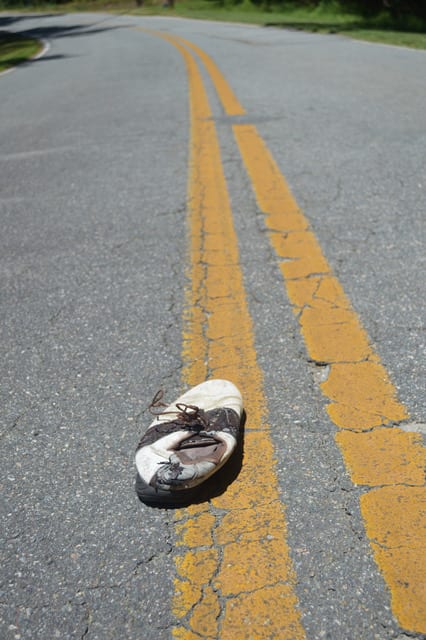
FQ: The shoe in the first story injects whimsy into an otherwise sad situation. Where did you get that idea?
WORSHAM: My friends and I actually did pass around the shoe at the time that our friend Carmen was dying with pancreatic cancer. That story is very autobiographical, what you might call a “found” story. I just strengthened the connection between the two.
FQ: You posit a group of female couples bonded like a family in Milledgeville. Is this a kind of camaraderie you have experienced?
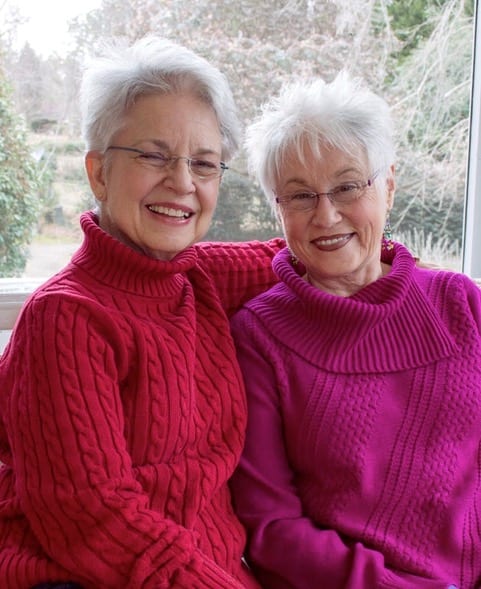
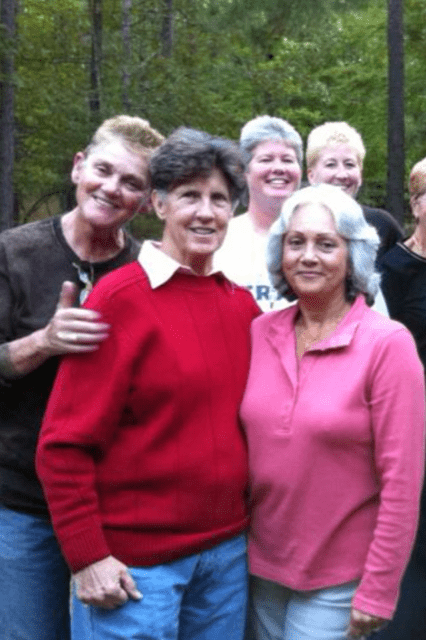
WORSHAM: Yes, and we consider ourselves very lucky to have one another. We don’t believe that what we have exists everywhere. When I first “came out” at age sixty-three, I was welcomed into the group. Now my wife Letha and I are part of this group. We meet at a local restaurant every Tuesday, and there are usually 15-20 women there. When someone gets sick, everyone rallies round, giving support. I remember early in my time of being with this group, I thought, “This is like a Baptist Sunday School class!”
My memoir, Going to Wings, published in 2017, is the story of this group, as well as the real losses I have experienced in my life.
FQ: The illustrations are quite striking though non-representational; how did you choose the ”right” one for each story?
WORSHAM: When the publisher saw Letha’s drawings, he immediately wanted them included. I left it up to Letha to match the drawings with the stories, and I think she did fit them together well. Look closer.
FQ: Do you have plans to keep Milledgeville as a setting for future works, as other writers have done successfully (example, William Faulkner with Yoknapatawpha County)?
WORSHAM: Yes, I do, like Sherwood Anderson’s Winesburg, Ohio. Milledgeville is the home of Flannery O’Connor, and I recognize her characters in mine. My head is filled with the fictional Milledgeville and its characters, some of them based on the real Milledgeville and its “characters.” Since I live here, I will never run out of stories.