Margarita Barresi does a magnificent job of blending history and fiction in her debut novel, A Delicate Marriage.
The story opens with Isabella Soto on stage. She is about to recite Manuel Fernandez Juncos’ poem, ‘La Serenata.’ It is September 1935, and the place is Puerto Rico. The students of the University of Puerto Rico are her audience and they anticipate her reading this acclaimed body of work. As she approaches the microphone, she catches her breath. She is not sure if her eyes are playing tricks on her, but she could swear Gardel, the Argentinian King of Tango was staring back at her from the first row. This isn’t possible, given he perished in an airplane accident the previous June. After collecting her thoughts, she shakes off the impossibility and recites the poem. Enthusiastic applause erupts after her reading and as Isabella walks off stage, she is greeted by Dr. Chardon, the University chancellor. He introduces Isabella to the mysterious and intriguing stranger she had earlier mistaken for Gardel. “…Ah, Senorita Soto, let me introduce you to one of our top students, Marco Rios, the chancellor said, welcoming her admirer with an enthusiastic pat on the back...” (page 10) That chance introduction was the beginning of how Isabella and Marco would forge a future together in time that neither could possibly fathom in that moment.
During the reception post-recital, Isabella and Marco have an opportunity to exchange pleasantries. While details of their respective backgrounds are not discussed, it is clear to Marco that Isabella has lived a life of privilege. Marco’s life and social status was vastly different. He was a jibara (a term used to refer to the poor people of Puerto Rico). He has struggled and worked hard for everything he had attained in his life so far. Isabella’s ‘Papi,’ Don Gabriel, is one of the most affluent figures in Puerto Rico and his plans for his daughter are to have her marry into a situation of equal wealth and stature. Isabella doesn’t see eye-to-eye with Papi’s vision of her future. She wants to be an actress and the only way to achieve this is to convince her Papi to send her to Mexico to study under notable directors like Miguel Contreras Torres and Fernando de Fuentes. The challenge will be to convince her father to agree with her choice. Perhaps meeting Marco was a divine intervention for her plan to become a reality. What Isabella had not planned for was to fall in love with this dark stranger. Maybe she wasn’t destined to become an actress after all.
A Delicate Marriage is Margarita Barresi’s debut novel, and I must give her huge props for writing a well-thought-out storyline that has more than enough meat on its bones. Her attention to the historical details of Puerto Rico’s history in becoming a U.S. Territory is fascinating. The period of time begins with the prologue and the torrent of the San Ciriaco hurricane in 1928 and ends with the epilogue in 2017; describing the aftermath of one of the most devastating hurricanes (Maria) to ravage Puerto Rico in the 21st century. She touches upon class differences between the ‘have’s’ and ‘have-nots,’ comparing privilege to the struggles the native people endure as she highlights the political diversities between those natives who are for U.S. support and those who are not. There is a tangible sense that Ms. Barresi did far more than sprinkle a few historical accounts periodically throughout the read. Rather, she strategically sited specific periods of time and unrest. One account she describes is when the dissent rose beyond a boiling point during the Nationalist party uprising in the 1950s. The unrest began with the "...El Oso Blanco, the massive penitentiary in Rio Piedras, killed two guards and injured another four. More than one hundred convicts were on the loose, spread over the Suan Juan area and beyond, like fleeing vermin, each desperately scurrying to safety..." (page 292). Ms. Barresi tempers the storyline in developing credible characters and situations as she infuses political discourse as the undertone to the storyline. There is a lot to absorb, but Ms. Barresi has written an incredibly engaging tale across the pages. The characters are richly developed, and the dialogue and scenery are captivating. I give this book a big thumbs up!
Quill says: A Delicate Marriage is rife with character and depth and a wonderfully educational look at the history of Puerto Rico.
Today, Feathered Quill reviewer Diane Lunsford is talking with Jacek Waliszewski, author of Midnight in Syria: The Special Forces Connection Series.
FQ: Thank you for making the time for a chat today. Let me start by saying your book is tight and has a fantastic storyline! I’d like to begin by asking a few questions about you. The quote you captured in the beginning by Langston Hughes "Hold fast to dreams. For if dreams die, life is a broken-winged bird that cannot fly." This is quite eloquently stated and I’m curious, is there a dream that died somewhere along your journey and how did you overcome the situation and keep moving forward?
WALISZEWSKI: This quote isn't about me, rather, it's about the dreams of the people who were caught in Syria in the middle of an unwinnable situation. To imagine how many dreams and aspirations were dashed at no fault of their own is an overwhelmingly sad reality, and Hughes captures this melancholy in his quote.
FQ: I applaud your views when it comes to the ‘publication game.’ We authors have certainly persevered and defied the odds because of self-publishing. It truly does come down to how well one markets oneself. What do you gravitate toward in terms of what works/what doesn’t when it comes to promoting your work?
WALISZEWSKI: It's no easy feat, that's for sure. Even though I've been in a documentary that won 3 Emmys, was Oscar shortlisted, and more, and with my prior success with Air Boat and great initial success with Midnight in Syria due to its relevance with what's going on in the Middle East right now, it's simply hard to balance a good story with "getting it out there." Case in point, Avatar 2 was a $300m movie, and they spent $150m in advertising. So self marketing is a great way to be forced into staying humble. I celebrate each and every sale of any book because I know I'm connecting with someone else out there, and I really hope they tell their family and friends about the book as well. So much of what is accomplished is by word of mouth, and by reaching out to book lover circles like Feathered Quill. It's also very difficult to get into national bookstores and large scale distributors - they have their calculated priorities. So finding the whitespace to navigate in (there's not much) is the impossible riddle.
FQ: I say a heartfelt thank you for your 18+ years of service as a U.S. Army Special Forces Green Beret! Your ‘disclaimer’ at the end touched my heart when addressing the reality (or not) of the characters and situations in Midnight in Syria. What is your philosophy toward the notion that truth is such a difficult thing to expose (and, more importantly, receive)?
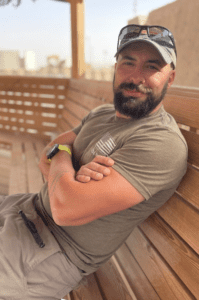
Author Jacek Waliszewski
WALISZEWSKI: Ah, if this isn't the ever driving question any philosopher doesn't ask themselves at least once or twice a day. Maybe I can share a story: I remember when I came back home from Afghanistan in 2021 right when the entire country collapsed - so much so that even my watch was still set to Afghan time. I was about to eat my first steak dinner at a restaurant, and the server asked where I'd been. I mentioned I had just come back from Afghanistan and that the country collapsed, and he looked at me quizzically and asked "Wait, we're still in Afghanistan? I thought we left ten years ago." I shrugged my shoulders and finished giving him my order. The point being, is that truth is available for all, it's the person who has to want to receive it.
FQ: Diving into the story, I was immediately enamored with both Dakota’s and Owen’s respective characters. There is an intentional sincerity that resonates when you pen both of their strengths, i.e., Dakota knows how to take care of herself, and Owen is definitely a man’s man, but between the two, you manage to shine light on their softer side without getting milky. Were there real people behind the fictitious characters and if so, have either of them challenged you with this notion?
WALISZEWSKI: The short answer is yes, Owen and Dakota are very real people. They read Midnight in Syria and thanked me for writing their stories in such a respectful, vulnerable, and real perspective. More so, I've met, worked with, or trained more than three thousand people in my career thus far, and I can't explain how amazing some of these people are. You get to know them in all sorts of situations, and as a "studier of people," I find it fascinating to watch people transform, rise to the occasion, or collapse under the stress - and when they see themselves after the fact and have to reason with their new reality of themselves, it's another transformation all together. Having seen and experienced so much, in others as well as myself, I try to balance this with what the reader needs to know, wants to know, and should know about each character, without bogging down the story itself.
FQ: In the end of Midnight in Syria, your final words were riveting: "Visually depicted...If each word in this story were a human, it would take eight books to account for everyone who has died, thus far." (pg. 247) WOW! Sometimes I believe the writing process is taken over through somewhat of a divine intervention. Was this a divine moment (or intentional placement)?
WALISZEWSKI: This was a depiction of reality. It's impossible not to be wrapped up and distracted in our own lives, and it's impossible to quantify everyone who's been lost along the way. But if you could imagine that you, or everyone you know, is a 'word' in a sentence, and that is a city block that was just destroyed, and cities were ravaged for years, then it becomes unimaginable - and that's just one page in a book of 'words.' Then draw that out over a chapter, then the book, then multiply that book by eight - then the scale and scope of 'broken dreams' cannot be appreciated, it's simply unfathomable.
FQ: Last (sort of) political question. As an American, I embrace the freedoms I still have to do my own research in hopes of finding truth. I can’t help but think important matters in the past handful of years are glossed over (at best), our freedoms aren’t what they were even a decade ago. However, in my opinion, this is not limited to the United States. It is happening globally. How would you "talk someone off the ledge from ranting" and teach them how to make a difference through action?
WALISZEWSKI: Ghandi perhaps said it best, where you have to be the change you wish to see in others. My Dad, for example, helped start the Polish Solidarity Revolution in the 1980s because he raised his hand during a large meeting and said "This isn't right, we can do more." And I've managed to stop or alter the course of negative events by raising my hand and saying "Is this really the best option?" - sometimes it just takes a person calling out the obvious - other times it takes a person saying "enough's enough, I won't stand for this." But in such a complicated world, there is no 'one size fits all' recommendation.
FQ: You have some extremely descriptive passages in Chapter 9, ‘The Devil’s Land’ talking about the sand fields that go on for endless miles. Yet, in the next breath, you talk about: "...They are parked in the horseshoe of a dominant lava outcropping and are hidden from sight..." (pg. 198) Have you been there? If so, give me an example of the beauty that you were able to behold in the moment and the impact it made on you.
WALISZEWSKI: I can't tell you if I've been there 😉 But I can tell you that I've been to several parts of the Sahara, and it is hell, beauty, and destroys your ego all at the same time, and without even trying. It, the desert, doesn't know or care that you exist, it's only you who knows you exist, and how insignificant you really are - because as you're standing on the desert, with dunes reaching a hundred feet tall, it's like being on the ocean, since there's a mile of sand beneath you as well. Once you start to see it from that perspective, you start to appreciate the life that exists, and you discover a special connection with those who have reached a similar understanding.
FQ: I have never been in the service but am surrounded by loved ones who have served and work now with active-duty military and veterans. I am humbled often and believe there are many brave men and women who walk this journey of life and have wounds my naked eye will never see given their experience(s). If you were asked to deliver a message of hope and healing, what would that be?
WALISZEWSKI: The pain is real, as is the tumult and frustrations associated with it. Imagine a ball of yarn wrapped in barbed wire and duct tape - it's complicated to see that, but it's even worse to have that within you and trying to undo it - since each component has its place, they just don't need to be mashed together in your mind or soul. So to those that are in pain or frustration, it's not easy, but there can be healing if we give ourselves the grace to accept what's happened, and talk to someone who has the empathy to listen (not everyone is a good listener, and not ever resource is beneficial, but if you keep looking and asking for help, you'll find what you're looking for.) I know many in the veteran community who have found great success with Equine Therapy, and that is a community that is truly a beautiful place because the horses can't judge you, they simply want to be there with you.
FQ: It has been such a joy to talk with you today and I want to thank you again for making the time to do so. I hope you have an endless series of books in this series and continue the journey of Owen and Dakota. Are you working on your next book and if so, could you give us a tease?
WALISZEWSKI: Absolutely! of Icarus is book 3 in the series, it's based on the true story of me as a bartender in D.C., just before joining Special Forces. But in order not to get in trouble with real world authorities, I'm "fictionalizing" this book as well, and once you've read it, you'll know why.
Jack meets Owen at his bar just before he leaves on his deployment (Midnight in Syria). Jack's life falls to shambles shortly thereafter, just when he's met the love of his life, and he loses nearly everything after an illegal venture with his roomate, where they counterfeited over a hundred thousand dollars. Owen returns to the bar, angry and with a thick beard, and has brought with him Luke and Kyle (from Air Boat, Book 1). They take Jack under their wing for a night out with some Navy SEALS in Virginia Beach, during which Jack sees a side of humanity he's never heard of and wants to be tied into. After that, Owen lets him loose, not because they've lost faith in Jack, but because the men seem to have lost faith in humanity. Alone again, Jack is forced to make the ultimate decision, listen to advice he's been ignoring for so long, or continue hiding from the truth. The decision is his.
Midnight in Syria: The Special Forces Connection Series
By: Jacek Waliszewski
Publication Date: August 15, 2023
ISBN: 979-8389371101
Reviewed by: Diane Lunsford
Review Date: October 9, 2023
Jacek Waliszewski delivers action to sink your teeth into in his latest novel, Midnight in Syria.
Confusion is the word of the day when Dakota rises from a comatose sleep. She is in a hotel—what hotel, she’s not sure. A lonely finch is perched on the windowsill curiously watching Dakota’s body slowly awaken. Dakota grabs her jeans and makes her way to the door. When she arrives downstairs in the lobby of the mysterious hotel, she is greeted with emptiness. There is food at the buffet, but again, nobody is around. She makes a plate and returns to her room. On her way to the rooftop terrace, she grabs the cumbersome satellite phone and settles in to make a call to her editor, Tim. Continents away, Tim is somewhere in Manhattan. Dakota is somewhere in (near?) Syria on assignment. She is a reporter, and her mission is to tell the world what’s really going on there. Slowly, her memory begins to process the circumstances that deposited her where she currently is. As the phone boots up, she notes the battery is declining. With a sinking thought, the first concrete memory surfaces. The battery was stolen… along with her camera. Was it yesterday? Two days ago? What difference does it make? Her current situation pales in comparison to the rollercoaster ride she is about to experience.
When Dakota finally connects with Tim, she can hear bombing that, based on the cloud of smoke in the near distance, is somewhere close to a suburb of Damascus. Shortly after the strike, the hotel loses power, and she ends her call with Tim. Dakota is waiting for her pickup. He is late, but he is also her ride to smuggle her into Syria. As the sounds of gunfire loom closer, she moves to the edge of her roof-top perch. In the faint distance a small blue Opel catapults out of a side alley and slides sideways as it makes its next turn. Now what? She takes refuge in her room in hopes of a ‘Plan B’ in the not-too-distant future. As the sun sets, she hears movement somewhere downstairs. Quietly, she makes her way to the lobby; fortunately having the foresight to grab a makeshift weapon. When she crosses into the restaurant, something reaches out from the shadows and takes hold of her wrist. It's fight or flight time and Dakota wastes no time to consider whether the hand belongs to a friend or foe.
I have not had the privilege to read any of Mr. Waliszewski’s previous books, but suffice it to say, they are now on my list of ‘books to read’ soon. Without a moment’s hesitation the reader is strapped into the front seat of an imaginary vehicle that will curb rails and zoom across pages of epic excitement! Waliszewski is the master of his pen and knows how to deposit sheer thrill and anticipation of ‘what’s next’ throughout this entire read. Passages such as: "...Dakota swings her dagger wildly behind her and there is a meaty slash. In return, her wrist is hit with a quick strike, and the impact sends a lightning bolt of pain through her arm. The blade hits the floor in a clatter, and she is thrown into the center of the restaurant where she stumbles over a chair and falls to the floor, taking the candle and tablecloth with her..." (pg. 14) Now that’s how you capture the interest of your audience! The main characters, Dakota (a reporter) and Owen (Special Ops, Army) are the real deal. The descriptions are rich and while there is some romance sprinkled here and there, Waliszewski is the master at not painting too much ‘cheese’ into any moments. He has stepped into the light with some action-packed, stand on its own merits, clear your afternoon, and get ready to read creative work! This is a book that is hard to put down until the proverbial ‘The End’ is staring you down. Well done!
Quill says: Midnight in Syria may be a work of fiction, but it definitely nudges the readers’ conscience to seek the answer to ‘why’ do we go to war?
For more information on Midnight in Syria: The Special Forces Connection Series, please visit the author's website at: https://www.storiesbyjacek.com/
Today, Feathered Quill reviewer Katie Specht is talking with K.J. Devoir, author of Brutal Intentions (Kings of the Order).
FQ: What was your motive for publishing this story as a set, including books one through three of the Brutal Intentions series?
DEVOIR: I wanted to write a dark paranormal wolf shifter romance about an old-money down-on-her-luck heroine and a new-money mercenary anti-hero being thrown together under mysterious circumstances in small-town Southern Florida. I wanted to push boundaries with a Byronic character like Shaw MacRath, but more so in the next book in the series,Savage Intentions, starring anti-hero Xavier Layne.
FQ: You have a new book releasing on October 31, 2023, entitled His to Haunt. What can you share with your readers regarding this new standalone thriller?
DEVOIR: This is a dark, steamy supernatural thriller/horror vampire murder mystery romance that takes place in a Northern California town with a strange, dark past (based on a real town) with an ancient Egyptian alien connection. This standalone might become part of a longer series.
FQ: While romance novels are nothing new, I can say with certainty that your book was the first of its kind that I have ever read. Combining the steamy romance narrative with shape-shifting werewolves was truly unique and captivating. Can you share a bit about where you derived the inspiration for this story?
DEVOIR: For me, dark crime romance meets paranormal is a useful hybrid creatively. I think shape-shifting creatures are a wonderful metaphorical vehicle for expressing human behavior, especially as it relates to romance, as well as a great plot device for exploring the criminal and political underground.
FQ: Can you share with our readers your favorite authors or authors you gain your own inspiration from?
Author K.J. Devoir
DEVOIR: Classically, I love Anne Rice, Stephen King, the Bronte Sisters, Austin, Shelley, Lovecraft, and the other Gothic and Sci-Fi horror greats. As for modern fiction, some of my favorite books are Owls Do Cry by Janet Frame, White Oleander by Janet Fitch, and I got hooked on the Twilight series. I have a huge cue of modern gothic romance and horror fiction to read.
FQ: You share in your bio that you studied English, Criminology, and British Lit in college. Can you share a bit about this background and how it led you to begin writing dark romance novels?
DEVOIR: Studying and falling in love with Victorian literature and the elegant madness of the era and the eras surrounding it, along with studying crime, did not turn me into a lawyer as planned. Instead, I wanted to combine my own crazy experiences with my studies and produce macabre fiction. So here I am. Romance a la the dark side. Hopefully, after a few years of writing under my belt, I will turn into the type of writer I would like to become. Still improving.
FQ: These three books are all part of the Kings of the Order series. What can you share with our readers about the next book(s) in the series? Will Shaw and Cherish make an appearance in the next book, or are you introducing new characters?
DEVOIR: Though some of my ARC readers would like for the story of Shaw and Cherish to continue, for now, the pair of them will be referenced in upcoming books rather than make appearances. However, that does not mean I will not return to Shaw and Cherish in the future, as I do realize there is room for continuation. For now, I am working on other projects, such as His to Haunt.
FQ; The plot of Brutal Intentions was quite multi-dimensional, with the romance narrative, the shape-shifting werewolves, and Cherish being in danger throughout the story. Then, towards the end of the book, you introduce the role of the Queen, and we discover that Shaw’s family is royalty. This was an unexpected plot twist that added to the overall excitement of the book. What made you decide to incorporate this rather unique aspect of royalty into an already gripping story?
DEVOIR: I love exploring old-world meets new-world, modern characters thrust into their ancient past. I enjoy history and reading about the pitfalls of power, then exploring this via fiction. From a romantic perspective, there is something sexy about a reluctant king. A man who does not want power but has it. So, it was fun creating a series around these would-be Kings of a defunct Order.
FQ: You have penned an impressive collection of dark romance novels to date. If you had to choose just one as having been your favorite to write, which one would it be and why?
DEVOIR: Before His to Haunt, I would have said Savage Intentions and the Kranky short story series, particularly Kranky Kringle which is somewhat inspired by The Crow, as this story is closer to where I am trying to go as an author: darker and deeper. His to Haunt is going to outdo them all. I’m growing as a writer, and I hope that His to Haunt will be as haunted as it is sexy. A proper combination of horror and eroticism, contemporary but rooted in ancient history. This is, after all, a vampire romance.
FQ: The characters in your stories are realistic, raw, brave, and uncompromising. How do you develop these unique, believable characters that readers can easily form a connection with?
DEVOIR: I studied theater arts during my first two years in college, and I read through a lot of monologue books, took acting classes, and even worked as an Extra for a bit. I love movies. When I write, it starts out as more of a screenplay than a book, mostly dialogue, and I cast my characters based on a mix of real people, actors, and musicians. Dialogue is probably my strength, and I am working on improving the structure and descriptive aspects of storytelling.
FQ: Your next book is slated for release soon. After that book is released, do you have plans in the works for writing future stories, or will you be focusing on promoting and marketing your current books for a while?
DEVOIR: In addition to possibly expanding His to Haunt into a series, as well as continuing with Kings of the Order, I plan to put out another short story collection soon. I do also publish YA versions of some of my work. If readers would like to join my ARC review teams on Book Sirens and/or Book Sprouts, all of my books as well as upcoming books are available on these sites to read and review.
Today, Feathered Quill reviewer Barbara Bamberger Scott is talking with Christine Macdonald, author of Face Value: From Working the Pole to Baring My Soul.
FQ: You're very open about your personal struggles in Face Value. Was there ever any hesitation in whether or not to include certain events? Did you ever discuss with a close friend (or friends) what you should include?
MACDONALD: I hesitated with all of it! A large part of my story is about how and why I found the stripper pole in the ‘80s and ‘90s, and after a harrowing, heartbreaking and hilarious decade, how and why I walked away. The location is a wildly popular tourist destination (Waikiki, HI), so I knew it would garner attention. Knowing this, I confided in childhood friends (noted in the book) asking how far down the dysfunctional rabbit hole I should go. I share quite a few experiences in Face Value but did leave some out, out of respect for all parties involved.
FQ: Was Face Value "living in your head" for a while before you started writing? Did you think about the benefits of sharing your personal experiences well before the pen started flowing? Was that perhaps the impetus for sharing your story?
Author Christine Macdonald
MACDONALD: Yes. Absolutely, yes. I knew having a career in six-inch stilettos and bedazzled G-strings in Paradise was unique; but I also knew that every one of us who found their way to the strip club had a story. Our paths may have been unimaginable for most, but our stories of longing for validation and acceptance are more common than we think. I still have pieces of paper, napkins, and notebooks with written memories all of which made their way to Face Value. There is even a scanned copy of a cocktail napkin (with a love letter written by a waiter from a club where I worked) from 1990 in the book.
The benefits in sharing my story far out-weighed any trepidation I had about lifting the veil of my toxic past. Before I began work on my manuscript that would evolve into Face Value, I created a blog titled Pole to Soul which garnered a healthy viewership. Once Pole to Soul was awarded Blog of Note by Google in 2010, the amount of subscribers blew up and as a result, I received emails from strangers across the globe, thanking me for sharing my painful past, helping them feel less alone. Part of my story includes living with a rare form of cystic acne, (Acne Conglobata) and most of the emails I received were from fellow sufferers of this disfiguring skin condition. These emails, in addition to my fellow sorority sisters from The Pole who have thanked me for giving them a voice, and my own passion for giving purpose to my pain, became the impetus for Face Value.
FQ: Given that much of your early life was in Hawaii, I have to wonder if you have traveled to or maintained any personal ties to Hawaii.
MACDONALD: I was raised in Honolulu and lived there nearly thirty years. My family is still there and I do visit when I have the chance, but even now, decades after my life as a sex worker and drug addict, my PTSD gets triggered when visiting. The moment I see a glimpse of the island through the airplane window upon our descent, I feel myself needing to remember to breathe. Hawaiʻi is a magical, tropical heaven for most who visit and live there, but when it’s the scene of the crime and genesis of childhood trauma, it becomes a different type of place entirely.
FQ: Speaking of Hawaii, so many people think that they can outrun their life issues by simply moving to a new/better place. But as you note, "Skin deformity on her face resulting in nine surgeries since age 15...childhood abuse, addiction, bullying, mental illness...All in the Jewel of Paradise: Waikiki, Hawai`i." So, what would you tell those people who want to "run away" from their problems?
MACDONALD: I am one of those people! I should clarify; I used to be one of those people. In my twenties, I thought relocating to a different zip code would magically wipe my slate clean, serving new opportunities with zero baggage, but I digress. Knowing that to be an adorable fantasy (popular with young adults and drug addicts alike), I would say to people wanting to move away from their problems that trauma knows no bounds. Sure, the views may be different, but until we dig into our why – the distance we travel is superfluous. Our baggage is self-tracking and will always find its way back to us until we address the reasons we have them in the first place.
FQ: You have created a scenario of behind-the-scenes pole dancing and other such activities; are you aware of any significant changes in that profession since the years of your involvement in it?
MACDONALD: Oh yes! When I started dancing on stage in the late eighties, there was no such thing as a pole dancing class or clear heels (“stripper shoes”). We were self-taught and worked in six-inch stilettos with a metal spike as our heel. We also used to wear elaborate costumes and performed semi-choreographed numbers. Another big difference I notice now in the clubs is that most dancers have beautiful tattoo artwork; this was something almost no one had when I danced. But the most surprising thing I learned from the women who work in the industry now is that most clubs charge their dancers a stage fee. For example, if they have a $200.00 stage fee, and only make $400.00 in tips one night, they take home less than half of that after paying their stage fee and tipping out the servers, bouncers, DJ and bar staff. That one still gets me.
FQ: I love your book promo video, and the text that goes with it - "Dreams coming true = hard work, belief, moxie." So true, and so, so positive. I love the positive message. How do you stay so positive?
MACDONALD: I just talked with my therapist about this question; it’s a good one. How does one stay so positive after a lifetime of trauma and challenges? I wish I knew, but I am so grateful to be. I suppose positivity is in my DNA, and the fact that I am addicted to comedy (watching stand-up comics is part of my mental health plan) doesn’t hurt. Having a sense of humor and the ability to see things through a healthier lens (drug-free) is paramount. Once we see life through a healthier perspective, finding gratitude for the little things become part of life’s big things: empathy, forgiveness, compassion, resilience, self-love, gratitude.
FQ: I see that you do speaking events - would you share a bit about these events with our readers? Do you give a brief overview of your life, the battles you've fought, how you've overcome them? What is the reaction from your audience? I suspect that many find it quite enlightening, given they may have similar struggles. Do some attendees (at speaking events or book signings) come up to you and share their struggles?
MACDONALD: I have spoken to private youth and women’s groups and am building my speaking resume slowly as Face Value gains momentum. I have Ted Talk dreams and of course, taking my story on the road for more book signings. Book events have been rewarding and humbling, as I receive many “so did I” comments in private. You’d be surprised how many retired sex workers are out in the wild! The most memorable interactions, however, are always with people who have struggled with mental illness (depression/anxiety), PTSD from trauma and Acne Conglobata. Sharing in detail, the severity of my case, the nine surgeries I’ve had to address scaring, in addition to being so open about my mental health struggles has connected me with some amazing human beings – all with their own stories of survival.
FQ: You've done a lot of writing for various publications - Salon, The Good Men Project, Power Women Magazine, to name just a few. Do you find it very different to write for magazines vs. writing a memoir? Is one more enjoyable than the other, or are both fulfilling, perhaps in different ways?
MACDONALD: The process is the same, but on a much different scale. Both are equally fulfilling once the pieces are complete. With writing essays, I typically choose one story from my past and craft a piece based on the theme derived from the lessons learned. With Face Value, each chapter is an essay threaded within the walls of how I got from there to here. My book is the grown-up, fleshed-out version of my old blog, Pole to Soul.
FQ: You have a link on your website to donate to RAINN. Would you tell our readers a bit about this organization and why they should donate?
MACDONALD: In the mid-nineties I was a twenty-something cocaine addict who danced naked on stage for money. I didn’t realize it at the time, but just a few years earlier at age thirteen, I was raped. I explain the story in Face Value, but the gist of it is this: I had no idea I was raped because of the particulars of my story. It wasn’t until years later and through therapy that I realized I was abused. Once I connected the dots with my past to the time of this discovery, I remembered that Tori Amos (a singer of which I was/am a fan) was public about her survival story. So much so, she became the first spokesperson for the Rape, Abuse & Incest National Network (RAINN). I was impressed by Tori’s openness and position of acting as an ally for other survivors, so I investigated RAINN further. I now speak about their organization through my social media channels and promote their work on my website. [*RAINN is an American nonprofit anti-sexual assault organization, the largest in the United States. RAINN operates the National Sexual Assault Hotline, as well as the Department of Defense Safe Helpline, and carries out programs to prevent sexual assault, help survivors, and ensure that perpetrators are brought to justice through victim services, public education, public policy, and consulting services. *Wikipedia, 2023].
Today, Feathered Quill reviewer Diane Lunsford is talking with Rebecca Beardsall, author of The Unfurling Frond: A Memoir of Belonging and Becoming.
FQ: It was an absolute joy to read The Unfurling Frond: A Memoir of Belonging and Becoming. I would like to begin by saying thank you and start out with a question or two about you. You have literally spanned the globe in the places you have lived (Pennsylvania, Scotland, Canada, Montana, Aotearoa/New Zealand, Bellingham, Washington). While the crux of your memoir focuses on New Zealand, please tell me something that stands out for you during your time in the other reaches of the world where you have lived.
BEARDSALL: I love Bellingham, Washington. It is like an oasis where I can be who I am without fear of judgment, and it is beautiful with the Salish Sea to the west and the Cascade mountain range to the east. Water and mountains and all the wonderful places in between. I particularly love all the walking trails around the city.
Last week, I thought about how lucky I’ve been to live in Montana, Scotland, and Canada. So many memories, like waking up to the sound of something chewing outside my bedroom in Montana, and when I looked out my window, there were six cows having a snack in our backyard. It was open range season, and it was my first time experiencing cohabitation with livestock roaming freely.
Bucks County in Pennsylvania is where I am rooted and where my ancestors reside, so it holds a special place for me, but I am not an East Coast girl, and I’m thrilled I no longer have to live in a place with poison ivy and humidity (ha!). But seeing the old stone homes and wandering about the not-so-little-now town that I grew up in always brings moments of peace. It is usually food I miss the most from home – like Pennsylvania-German specialties: funny cake, sticky buns, pumpernickel bread, soft pretzels, well pretzels in general – I love to tell my friends out here on the West Coast that in Pennsylvania, we have a whole grocery store aisle for pretzels (not pretzels mixed in with chips and other snacks – just pretzels).
One of my random memories in Scotland includes the afternoon my friend Jenny and I were walking back to work after grabbing some salt and vinegar chips (French fries). I believe I was the person holding the paper-wrapped bundle between us as we dipped our fingers into the gloriously salty and soggy chips, when some guy walking by put his hand into our chippy bag and took some, shouting a “thanks” as he walked on by. I was too shocked to even respond.
FQ: Your bio also notes that you are the nonfiction editor at Minerva Rising Press. If you had to impart words of advice on the art of writing nonfiction, what would that be, and why would you suggest that as key to their writing process?
BEARDSALL: Sadly, I recently resigned from Minerva Rising Press as their creative nonfiction editor to focus on my new work of offering creative writing MFA-like/Graduate level seminars for writers. Working for Minerva was an amazing experience, and I am so honored to have had the opportunity to work with such talented editors and writers like the memoir award winners I worked closely with, Janice Airhart and Jennifer Rieger.
With all writing, finding the genre that works for the story you want to tell is important. I was recently telling my students that I thought I was going to be a fiction writer, but I swiftly realized that was not my place – it couldn’t hold the story I needed to tell. I often bridge the space between poetry and creative nonfiction, but for me, the real delight is in form and technique. Our lives are layers and layers of story, and for me, creative nonfiction is my place to explore those layers. My best advice is to try all the genres, don’t lock yourself in, and let the story you need to tell direct you.
And read...read wide and deep in all the genres. That is one of the reasons I started offering courses to help students dive deep into texts, study the methodologies, and learn to read like a writer. I wanted to offer the same rigor of attending an MFA graduate course without all the stress of grades and a degree program.
FQ: You cite a myriad of works as sources (and references) in your book. I am a huge fan of Lewis Carroll and noticed you quoted him often. I don’t think I’m being presumptuous in stating it would appear you are quite a fan as well. Who is your favorite character in Alice’s Adventures in Wonderland (and why this character)?
BEARDSALL: It was a necklace that prompted me to read Alice’s Adventures in Wonderland a couple of years ago. Prior to that, my exposure to the story was indirect through theatre, ballet, and films. The story has been told repeatedly in multiple genres, but only in the reading did I see the connection to settler colonialism.
As for characters, I am partial to the Cheshire Cat (and the Rabbit). As a child, and even today, I am drawn to animals. I have a sweet little bunny living in my lavender that I check on daily. And I have a real Cheshire cat in my house; the storybook cat was based on the look and grin of the British Shorthair cat breed. Myla is my second British Shorthair after our first British Shorthair, Myrtle, died in 2020 at the age of fourteen. A cat with big fluffy cheeks, a stocky build, and a smile, what is more fabulous than that?!
FQ: I was intrigued about the vibrations and (voices) that you sense. In your opinion, do you think there is a connection between meditation and how to open the channels to our inner self to awaken what the naked eye may never see (or the ears may never hear)?
BEARDSALL: I don’t really practice meditation. I have from time to time, but it is not how I really get connected. It was only recently that I returned to prayer as my form of meditation. I was taught as a child to pray, and in some way, I always kept the practice but didn’t initially connect it to the way others use meditation. Prayer for me is a release of self and a conversation – it is no longer the space of pleading and asking for forgiveness like it was when I was a child. I see them as reaching the same goal but through a different methodology, which seems so fitting for the person I am – taking what is known and recreating it in a new way for a new purpose. I also walk a lot, and that is often when I get in the zone of connection.
The big thing for me is to not be afraid or scared and to know that I am protected. I’ve wavered between the space of wanting to grow my skills to wanting to forget about them completely. However, a spiritual gift is a gift, and we have a choice to accept or reject it. I have finally accepted it.
FQ: You write many compelling insights throughout the book, but one that gave me goosebumps was: "...Alice has a cat as her guide, but it is always appearing and disappearing—a hint to spiritual gifts and the role of God/Spirit in my life. I’d say the most haunting aspect that resonates with me is the waking up in ‘home’ and realizing the work of continuing to understand self and place remains..." Elaborate on this further, please. This is very powerful.
BEARDSALL: The way a place sits inside you even when you are not there, and it can rejoin you at a moment's notice. In the book, I talk about that happening to me in Oahu. I can’t even really explain the strangeness of that moment. It was as if I was transported in time and place back to Auckland circa 1998. And when I looked up, I couldn’t understand where I was and why my room no longer looked like my room. I was in a hotel, not our apartment. It was seconds, but it felt like hours. I never quite know how those moments happen, but I know they do when I allow space for them to happen. I can feel and know I am in one place, but the reality is I am in another.
So, when struggling to think about belonging and can we really belong to a place, it haunts me that I can wrestle with that concept of “can I belong,” but at the same time, I can feel the place within me. And maybe that is Aotearoa and the spirit that resides there. And if that is the case, I feel blessed and honored to have it rejoin me and remind me that I, too, in my own way, am part of its story. The last line in that paragraph is: “To belong while always knowing belonging is impossible.” It is a haunting and a blessing.
FQ: In your acknowledgments, I applaud you for giving a shout-out to the STWP Literary Awards Program for the best compliment - "We loved the strange coolness of this manuscript...” There is a lot of ‘strange coolness’ to this body of work. There is an inherent undertone of spiritual connection and I wonder what other positive feedback you have received because of the mechanics of the storyline.
BEARDSALL: Strange coolness was like music to my heart. I’ve always pushed against the norm while still trying to maintain a sense of belonging, so those two words encapsulated the two – strange (my original self) and coolness (being part of the world).
People have commented on the weaving of poetry, flash nonfiction, essays, and, of course, the use of photos.
I decided to use the hermit crab method, a lyric essay technique named by my MFA professors Brenda Miller and Suzanne Paola in their book Tell it Slant. The hermit crab essay borrows a form to tell the story, and it did this in The Unfurling Frond using a memo to myself. Most of the people I’ve talked to about the book comment on the powerful use of the form and that it was a surprising method. I went with the memo, originally designed on the concept of the Microsoft Word template style, because it was something we used a lot in the mid-90s when the use of email was still in its infancy.
FQ: I enjoyed your scene about the tea party Alice joins uninvited. While they all (The March Hare, Dormouse, and Hatter) tell her there is no room at the tea party, she sits down anyway. Yet, it is the Hare that states: "It wasn’t very civil of you to sit down without being invited." Have you ever been in a situation where everyone feels the same way, but you’re the only one that actually says something out loud? What were the circumstances, and how was it received when you spoke up?
BEARDSALL: I am laughing not because of the question but because of the real examples that come to mind. I am often the person people turn to when the room gets awkward. I’ll hear the whispers, “Oh no,” “Rebecca, do something.” And in those moments, I do what I do best, offer a practical thing to do. Provide a call to action...like saying, “Well, thank you, everyone. That was great. Please help yourselves to some refreshments.” Or “Okay, well now it is time for a picture. Everyone outside.” It is quite odd that I have become this person in social gatherings when I would classify myself as socially awkward, but I know how to manage a situation and read the energy in a room.
FQ: On one of your later visits to New Zealand, you talk about your journey to the north ends in Auckland, but your trip continued to visit your husband’s brother, who lives in Urenui Taranaki region. Your reference the word ‘pa’ "...The Battle of Te Motu-Nui took place in the land between Okoki pa and the ocean..." I don’t understand what the word ‘pa’ means. Could you please enlighten me?
BEARDSALL: Pā refers to a Māori village or fortified settlement. Most were on raised ground utilizing the volcanic terrain of Aotearoa New Zealand. I am glad that you asked because I purposely decided not to translate te reo Māori into English in a few places in the book. Aotearoa New Zealand's two official languages are Māori and New Zealand Sign Language, and English is the de facto language. As a writer using other languages besides English, we are asked to translate it or provide a glossary; I don’t think that is necessary. It is especially not necessary in the Google world we live in. I’d much rather someone look up the word pā and go down a rabbit hole of learning than be simply fed the answer. We live in an amazing world with many people, cultures, and languages. Why not celebrate that and delight in the ways that we can share a conversation?
FQ: If you were asked to teach a class on past, present, and future, where would you place the most focus? I ask because you allude to the importance of past and future (and the circular motion of history coming around and will eventually meet with the future). Where does the present fit in? No disrespect intended, I’m just curious how you would map out a class on this subject matter.
BEARDSALL: I believe the present is the meeting of the past and future. The past is ahead of us, guiding us, and it keeps us grounded in the present. You can’t have a future without the past and present. The difference in the spiral understanding of time is that the emphasis is not on the future, which is inevitable, but on the learning, connecting, and understanding of self in the present and in the past. We are layers of time, not a single moment in time.
I have always had a different way of looking at time, and learning about the spiral of time gave me a theory and terminology to use. I’ve often received weird looks when I try to explain my understanding of time, but the only way people can really move into the space is to release the concept of time as linear. You remove the line from point A to point B, and now past, present, and future no longer have a specific place to be, and they can move to where we need them, not how we understand them. The spiral is a symbol of how time moves in and out simultaneously. The fern is often used to represent this, which is why I went with the book title The Unfurling Frond to represent the way time has moved through my life.
FQ: I want to thank you again for the privilege and honor to chat with you today. In my opinion, you have gifted the reading world with a body of work that is a tremendous source of guidance and introspection. Please tell me if you are working on your next book, and if so, are you able to share what your next writing adventure entails?
BEARDSALL: Thank you so much. The honor is all mine. I am delighted that you enjoyed the book and that it resonated with you. I have another book manuscript completed about my brother, who is mentioned in The Unfurling Frond. He died at the age of twenty-five in a farming accident when I was nineteen, and that moment altered my life, which I go into more detail about in the book. That manuscript is “resting,” as I like to call it. I had a few beta readers and a copyeditor go through the manuscript, so I know it is in a pretty good spot, but in the resting, I let it go to just be. I will return to it maybe sometime next year to see if there is anything else I need to add or remove. The editing process is just that...a process.
As for my next book/project that I am starting, I have some theories about the Little Red Riding Hood narrative...my famous last words before an obsession takes over. The layers, multiple versions, and the notion of the journey from mother to grandmother intrigue me. I believe it is time for me to step into the forest with the young girl in red and see where the narrative takes me.
The Unfurling Frond: A Memoir of Belonging and Becoming
By: Rebecca Beardsall
Publisher: Atmosphere Press
Publication Date: October 10, 2023
ISBN: 978-1639889556
Reviewed by: Diane Lunsford
Review Date: August 7, 2023
Rebecca Beardsall’s The Unfurling Frond: A Memoir of Belonging and Becoming is exceptionally thought-provoking and a memorable journey of self-definition and personal reflection.
The prologue to The Unfurling Frond, ‘Blank Slate/White Bag’ is the key that opens Ms. Beardsall’s journey into ‘defining herself’ over the many years ahead in her journey through life. She was in her twelfth-grade art class and the assignment presented was the ‘white bag project.' The students were each given a white bag with the task to "...illustrate a bag that would represent a product that said something about ourselves..." (pg. 3) Inspired later that evening by a Ralph Lauren ad in Seventeen Magazine, Ms. Beardsall is drawn not only to the simplicity, but the impact it made. It was an ad for perfume and the bottle simply had the name ‘Lauren’ on it. Suddenly, she was inspired to design an image depicting "... a blue, round-shaped bottle with a wave-like cap in dark blue. Water, ocean waves—the elements that sing to my soul..." While the premise of this account is foundational to the memoir about to unfold, this was a defining moment that, in time, would guide Ms. Beardsall to leave her birthplace in a small Mennonite community in Bucks County, Pennsylvania, and "...wander and find places to hold me and become home, Aotearoa New Zealand, Bellingham, Washington..."
The story begins with Ms. Beardsall sharing the story around the tragic loss of her brother Dwayne. He was 26 years old and on March 13, 1992, Dwayne died from a horrific farming accident. He lost his life when he fell into the feed mixer after the evening milking and sustained multiple injuries to his neck, chest, and legs. Ms. Beardsall was nineteen when she lost her brother. He was supposed to be the best man in her wedding one day. Dwayne, in many respects, was her anchor that kept her tethered to Pennsylvania. As she eloquently puts it, her loss "...loosened the soil that bonded me to Pennsylvania but still holds Dwayne. It wasn’t a vision that caused me to venture; it was a life lost in an instant that spurred me to move on and into myself..." (pg. 14) This was her catalyst to not only go to whatever far reaches she needed to go to in an effort to seek and explore who she was, but maintain the hope that once she arrived, she would recognize herself. New Zealand is her eventual destination and where she finally meets her former on-line dating partner (Geoffrey) in the flesh and marries him.
It is difficult to pay proper respect and deliver a worthy critique to this author in two short paragraphs. Suffice it to say, Ms. Beardsall has done a stellar job of eliciting an instant connection with her audience immediately upon reading the first couple of pages. Ms. Beardsall extends her hand by way of beautiful prose and eloquent passages that are telltale signs of an author who is in command of her pen and has a clear vision of her audience. She drew raw emotion from me at the onset when sharing the epithet on her brother’s headstone: "...Vision to Venture are the words engraved on his headstone. They rest there in granite on the bottom right under: Dwayne E. Helm May 18, 1966, Mar. 13, 1992..." (pg. 13) Ms. Beardsall’s gloriously exposes who she is through emotions that range from heartfelt grief toward the loss of her brother to setting up the opening to many chapters in Section II with the whimsy of Lewis Carroll via select passages from his iconic Alice’s Adventures in Wonderland. There are also insightful thought challenges at the end of certain chapters that provoke moments of introspection. They are presented in either an obvious context (‘upright’) or a challenge to dig deeper (‘reversed’) in that the sentiment is worded similarly, yet quite different simply by how the words are assembled in the sentence. In other words, there are no ‘right’ or ‘wrong’ answers. Rather, they are intentional pauses to take (and make) the time to digest the content and look at what has been offered in a different light. Simply put, this is a body of work like no other I have read! I am honored to have had the privilege to write this review. Write on, Ms. Beardsall! The world anxiously awaits your next book!
Quill says: The Unfurling Frond is a magnificent garden that produces an amazing bounty of beautiful insights!