By: Georgina Le Flufy Illustrated by: Francisco Fonseca Publisher: Ethicool Books Publication Date: September 2020 ISBN: 978-0648872313 Reviewed by: Holly Connors Review Date: January 5, 2021
A quaint little village, full of vibrant colors, and a child's curiosity are the backdrops for the charming new children's book, April's Window.
April is a little girl who is watching the world go by from her window. While we only see April from the back, in the eye-catching cover illustration, we get to follow along with her within the pages of the story as she investigates each village window.
Open the book to the first page and we see the entire village from April's window - what April sees every day. And with a child's imagination and curiosity, she explores all those windows. What might each window share with the world?
As we stroll around the village with April, we see so many beautiful windows, every one with a unique story to tell:
Windows where people are watering plants, Windows where people are learning to dance. Learning to sew, Learning to cook, Falling in love with the words of a book.
Each of those windows has a lovely illustration of said window. We see a woman watering shelves of brightly marked flowers with a cute little watering can. Flowers are exploding off the page, with flowers behind the woman, on the windowsill, in front of the window and even off to each side. Another window shows a grandmother teaching her grandson how to sew - the love they share flows from the page.
Tall windows, Dark windows, Windows with hearts. Windows with rainbows and kids making art.
While it's not stated in the story itself, but rather in the book's description on the publisher's website, April is at home because of the pandemic. While children today are having to deal with the stresses brought about by the pandemic, the author has made the decision (a good one, I believe) not to make that an issue in the story. Rather, April is like all other children around the world right now - not able to go into friends' homes. The author, through April, encourages children reading the story to imagine what might be behind the windows on their own street, or hometown. The story is simple, with a very positive message, and conveys that warmth and happiness to the reader. The illustrations are by the very talented Francisco Fonseca, who shares his unique talents, with vibrant, playful images that bring the story to life. The last few pages of the story is a tribute to all the nurses, police, and other first responders who have kept us all safe during these difficult times.
Quill says: April's Window is a wonderful story that brings a small village to life through the eyes of a child. Perfect for children 6 and under, this will undoubtedly become one of your child's favorite bedtime stories.
For more information on April's Window, please visit Ethicool Books.
Today, Feathered Quill reviewer Anita Lock is talking with Isu Yin and Fae Yang, authors ofGrims’ Truth Book 1: The Spinner’s Web.
FQ: Which authors would you say inspired you to become writers?
YIN: For me, I’d have to say Tolkien, Lovecraft, Isaac Asimov, Dean Koontz, Clive Barker, and others to be certain.
YANG: This is difficult for me to answer because I didn’t originally set out to be a novelist. I aspired to be an artist, but I ended up being a better writer and it seemed much more achievable to turn such a large project into books. I enjoyed reading when I was younger but I wasn’t specifically inspired by any particular authors. However, I have enjoyed Albert Camus, Haruki Murakami, and the unique descriptions in Clive Barker’s work.
FQ: What books drew you to zero in on fantasy as your chosen genre?
YIN: It wasn’t what I read but what I didn’t read that drew me to work on Grims’ Truth. Fantasy had these great big worlds that felt full and deep. I loved that but I had a hard time suspending my disbelief in a lot of it. I wanted other elements to my fantasy. Something that made it feel rough — gritty even. I like horror and existentialism for these qualities. They feel dirty and often made me queasy, which sounds like a negative, but it really struck me and this stuck with me. In yet another way, I was naturally drawn to sci-fi for the incredible imagery and mind-blowing concepts, but it often seemed too clean, too empty. In the end, I wanted something that had it all. There are authors that do that for me. More and more, I see incredible writers pushing boundaries. I love it. I want to join them in the ultimate storytelling experience.
YANG: Yin’s answer was kind of incredible. I wish I had something that honorable to say but I didn’t really think about the genre that deeply until I had already written for several years. I never really stopped to think, “Oh, wow, what genre should I write?” Grim took a life of its own and I let it drag me along for the ride. Somewhere along the way, I realized that it was existential, fantastical, and even gritty. These are things I love in a story, so Yin and I work hard to bring something unique and full into this world. In a way, I want it to feel real and raw despite the elements of fantasy.
FQ: “For as long as we can remember, we have been either plagued or blessed with dreams of the vast universe we call Euphoria.” What would you say sparked your dreams that eventually inspired the Grims’ Truth series?
YIN: Good question. The Universe? Who knows? My dreams have had a life of their own for as long as I can remember. I’m just the passenger and I don’t tell them how to voice themselves— I just write it down so I can sleep.
YANG: I think not knowing is part of what compels me to write it. Readers often jokingly say that not fully understanding Grim is part of reading it and I feel that it is the same for us co-authors. We understand the Universe entirely but how it got there? Well… I suppose that’s a mystery in itself.
FQ: There are a total of sixty books in the works for this series. What stimulated you to create such an ambitious project?
YIN: Sixty books is not an accident — it’s quite intentional and that's about all I’ll say on that. It may seem ambitious, but I often worry if we can fit it all in.
YANG: Compulsive desire? Obsession. Like Yin said, everything is very intentional. The book count, the arcs, the organization of the series as a whole. We outline our plans over and over to make sure we can fit everything in. We’re asked how we intend to keep things interesting for sixty books and, meanwhile, we’re stressed about fitting everything into sixty books.
FQ: Your strong imagination has produced an incredibly detailed kingdom that includes relatable characters. If you were to put yourselves in the story, which characters would you wish to be, and why?
YIN: Each book is from a new perspective, so I guess I would have to say all of them. I live with them as I work on their part in the story. I’m not sure I’d wish to be any of them though. This is a dark story. I’d like to be someone before the Fall I think. That comment probably doesn’t make sense yet, but it will. LOL, that’s just the way of Grims’ Truth.
YANG: Yikes. I can’t imagine anyone wanting to be a character in Grims’ Truth. They suffer too much. Though, readers might identify with different characters. That said, there’s definitely a character whose lens I gaze through when I’m working. It’s not much of a secret but I still like to see who readers think we’re most like rather than answer directly. It’s part of the fun!
FQ: What do you envision to be your ultimate target audience, and why?
YIN: Adults or teens with adult minds. There are some disturbing situations in the series that would be excessive for a young mind.
YANG: I find that our readers are usually either mid-twenties or in their forties. Occasionally, we have senior readers as well. I suppose we exist in a peculiar corner because of the cross-genres and complexity of the series. Sixty books is a long commitment for anyone. Readers who like to pick up context clues and read between the lines tend to enjoy the series the most. What I hope for is an audience who will debate over details and theorize. The story isn’t black and white, so it needs an audience who yearns to explore the areas of gray.
FQ: Are there any plans forThe Spinner’s Webto become a movie?
YIN: I would love to see this story in a visual medium. If only people could see what we see… now that would be something. A movie? The story is so big. I’m not sure how one would accomplish it effectively. A series maybe? Trust me when I say that it’s even bigger and more impressive than we can write so turning it into something people can see would be ideal. We do our best, but it has a mind of its own. I’m open to anyone who wants to tackle this beast with us though.
YANG: I agree with Yin. I’d love to see this in a visual medium but it would need to be a series because of the size of the story. I think we reasoned that a season per arc or two seasons per arc, depending on the length of the episodes, would be most effective. Visually, Grims’ Truth has a lot to offer. Like Yin said, we do our best but we’re still learning to maximize its potential.
FQ: Do you foresee continuing writing fantasy once you’ve completed the series?
YIN: I started laughing a bit when I read this. This series is so massive and encompassing that it is hard to see past it sometimes. In all honesty though, we both have side projects that we work on.
YANG: What Yin said. If I’m being entirely honest, we have this entire series mapped out and it’s a twenty-year plan if we launch an arc a year. Even though we have other projects, Grims’ Truth is all-encompassing. We really must dedicate every spare breath to it. Sixty books isn’t the entire history of this Universe, so who’s to say we won’t branch off into more Grims’ Truth after this? Even we don’t know.
FQ: What words of encouragement would you give to those who have dreams of becoming a writer but are afraid to take the plunge?
YIN: A: You can’t succeed if you don’t try. B: Don’t avoid it — even if it scares you. C: Don’t overthink it. Get it down on paper and then once you have it — rework it until it’s what you want.
YANG: Write for yourself as much as you write for others. There’s a fine balance between the two. Find the right motivations to do it. If you’re passionate, you will overcome obstacles, even within yourself. Despite what you think, there’s always room for improvement. Don’t assume that your first draft was perfect. If you feel it was good, make it even better. Ask yourself what you love in a story and constantly study the craft. Someone out there can appreciate your ideas but it’s important to write well so that they aren’t distracted from your work.
FQ: You include a Book Club Guide at the end of the book. Do you have any other plans that would help engage the reading community with your series?
YIN: We made a full and growing database. It’s complete with images that we both made. You can see how we see the characters, regions, and much more. We have maps of the locations, a general breakdown of the Language of Ages, Clans, Breeds, Factions, and the likes.
Like I said before, this series is massive. We want to help readers immerse into the universe Euphoria— learn about the people, their cultures, governing systems, and beliefs. This isn’t a simple story. If it appears straight forward, look again. Our beta readers have almost systematically returned to The Spinner’s Web after completing Arc 2. I think it takes a minute for people to realize how far we’ve actually gone. It’s a bit deceptive, but that’s just how this story goes. Neither Yang nor I want to keep the lid on this story. I can’t even tell you where it is, and I have no intention of looking for it. That being said, we have mapped it out to the point of obsession.
The series is designed to take you somewhere else and yet feel an uncomfortable familiarity as the reader delves deeper. There are no accidents in Grims’ Truth — you found a mistake? Are you sure? Maybe you should rethink it and try to imagine the scene in a different perspective. We have multiple main characters so the reader will grasp the severity of what is coming next. No single perspective is without flaws.
Film producer Robert Evans said, “There are three sides to every story — yours, mine, and the truth.” For Grims’ Truth you must follow the varied perspectives to discover the truth and in a universal scale story — there are a few.
YANG: Yin just about covered everything. The biggest part of reader engagement is the engagement that readers have with each other. That probably sounds redundant but since this whole series is about perspective, it takes numerous reader perspectives to piece everything together as well. Beta Readers who sit down with us to discuss the story usually come up with new theories together because they process information differently than each other. We’re frequently asked if it’s possible to figure everything out before the infamous book 12. The short answer is yes. Going back to The Spinner’s Web from later books will make the information you previously missed very glaring. Readers always come back and say, “I can’t believe how much you two put in plain sight. It was in my face the whole time.” Indeed. We’re not trying to pull a fast one.
Washington Territory's Grand Lady: The Story of Matilda (Glover) Koontz Jackson
By: Julie M McDonald Zander Publisher: Chapters of Life Memory Books Publication Date: October 2019 ISBN: 978-1939685421 Reviewed by: Barbara Bamberger Scott Review Date: January 4, 2021
A pioneering woman embraces adventure, suffers loss, and lives on with pride and well-deserved recognition in this stirring, fact-rich history by Julie McDonald Zander.
Matilda Glover was born in Maryland, when the vast lands of America had yet to be occupied much beyond the east coast. Her parents, who were opposed to slavery, moved to Missouri, at that time not allied with the institution of slave holding. There she grew up and married Nicolas Coonse (spelling later changed to Koontz). Their first year of marriage was marred by the economic Panic of 1837, an enormous flooding of the Missouri River, and a cholera epidemic in the state and beyond.
When the Oregon Territory was officially designated, Nicolas, like thousands of other intrepid settlers, resolved to move there with Matilda and their four boys. Traveling the 2,000-plus miles by wagon, carrying hundreds of pounds of supplies to keep the family fed, clothed and protected from hostile influences, Matilda cooked and cleaned and watched over her sons. Tragedy struck when Nicolas drowned in the Snake River, and the then-pregnant Matilda suddenly gave birth to a child who lived only a few days. Yet turning back was not an option. She and her sons pushed on to the Willamette region of northwest Oregon. There she met and soon married a vibrant, entrepreneurial Englishman, John R. Jackson. With him she would become a much-celebrated hostess, entertaining in his various enterprises such notables as Generals Grant, Sheridan and McClellan. At her death, she was remembered as so staunchly attached to home and hearth that she had never ridden a train, and had seen one only once.
Author Zander has used diligent research to focus sharply on this courageous female, distinguished by her intelligence and her grit in the face of loss and hardship. Matilda’s granddaughters later sought to immortalize her, chronicling her daily life, stressing that those who came her way were always treated to warm hospitality and excellent, if homely, cuisine. Through the many letters and papers written to, from and about Matilda, we learn that she was a woman of Christian faith who never wavered and often inspired those around her. With Jackson she helped found and operate the region’s first courthouse (formerly their humble cabin home), engaging in patriotic activism—including helping to sew the first American flag—for the newborn State of Oregon. These historic papers, with their archaic spellings and highly formal prose, give a meaningful glimpse into the settler mentality.
Quill says: Well organized by reporter/editor/publisher Zander, Washington Territory’s Grand Lady pays due homage to a hardworking, determined pioneer woman in all aspects of her long and distinguished life.
For more information on Washington Territory's Grand Lady: The Story of Matilda (Glover) Koontz Jackson, please visit the website: www.chaptersoflife.com
Today, Feathered Quill reviewer Holly Connors is talking with Ruth Maille, author of The Power of Positivity: The ABC's of a Pandem.
FQ: Your background is in running a licensed family daycare/preschool. How has the Pandemic impacted your business? How do you stay positive during such a difficult time?
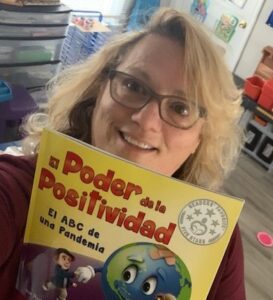
The author with the Spanish edition of her book
MAILLE: The Pandemic has affected my daycare in so many ways, besides the obvious new rules and regulations. I remember the first week I was off. I was sad, lonely, depressed; I had all these thoughts like, is this what retirement will look like? Does my world consist of only my kids and my daycare families? As much as I loved that part of my life, there had to be more. But what? I felt like I had no control over my life, and I didn't. It took about two weeks to shake those thoughts. It was when I embraced that time off, let go of the control that's when I began to see it differently.
I have always been a positive person, looking for that silver lining even in my most difficult times, so I embrace the time off. It had been 30 years of owning my business, and I never had more than two weeks off per year. So I wrote a list of what I wanted to accomplish and began checking off the items one at a time. One of those things was to write and publish a children's book.
FQ: You're also a certified, licensed parent-relationship coach. Would you tell our readers a bit about this training and how it helps you when working with both parents and children?
MAILLE: My training has helped me to understand children at a deeper level. Most people think children misbehave on purpose. However, they react in an instinctual way, out of fear or frustration caused by the unknown.
I help them to recognize their emotions and the effects of their emotional responses on those around them. I help them to work through their feelings instead of acting out. I have helped them use this tool: ask yourself, What if the other person is not misbehaving? What if there is a good reason why someone, children, and adults are doing what they are doing? Then approach it with curiosity and listen to learn. This curiosity has helped children and adults to understand one another.
FQ: Have you been able to run your daycare during lockdown? What impact have all the changes to daily life (mask-wearing, social distancing) had on the children you work with/care for?
MAILLE: I was shut down for over several months. During that time, I attended many zooms to learn about this virus and help my families. I knew some of the new rules would not be easy. Social distancing and mask-wearing were probably the hardest.
One of the beauties of family daycare is, everyone becomes a part of each other's families. Lot's of love, hugging, and support. So helping the children understand that while we fight this virus, we need to give each other space, wash hands, cover mouths, etc was a challenge, especially when you have 2-5 year olds.
Wearing a mask is one of the hardest things. Although the children in my care are not required to wear a mask, adults are. Masks tend to be scary at first because children read smiles. They rely on social clues through body language, facial expressions, tone of voice, or words. So being extra aware of that has been very important.
FQ: The Power of Positivity is your first book. What inspired you to write it?
MAILLE: The inspiration for my book was my daycare children. I have always wanted to write a children's book, and I have dabbled in it a few times but never knew enough about publishing actually to move forward with the story.
During this Pandemic, my daycare/preschool was closed during phase one. I wanted my daycare children to feel connected to one another,so we would do daily zooms together. We would read books, exercise, show and tell, circle time, and give them some sort of assignment to keep them busy. We would post on our facebook group sharing our creations. I found this to not only help them but me as well.
One day on the zoom, one of my children looked so sad and lost. He was missing his normal routine and his friends. I opened a conversation so that the children could share what they were feeling and what I found was that most of them were feeling the same way, sad, lonely, scared and confused. Children shouldn't have to feel these emotions.
I am a very positive person, So I started to brainstorm all the good that has come out of this difficult and challenging time. Everywhere I looked, I could find nuggets of kindness, love, and compassion for others. That is when The Power of Positivity, The ABC'S of a Pandemic, was born.
FQ: Writing a children's book about a current event is a difficult and very time-sensitive task. How long did it take you to put the book together, and did you ever feel rushed to get it published?
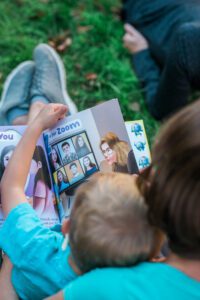
Mom and son reading the book at the book's launch
MAILLE: Believe it or not, writing the book was super easy. Looking back, when you believe in something or someone, in this case, the children, the words just flow. My heart was so sad that children were stressing over the uncertainty of this virus. Their lives were in chaos. Some children didn't have the vocabulary to share what they were feeling. Parents were doing the best they could but juggling distant learning, work, caring for small children at home now, worrying over finances, and not knowing what the future caused a whole new level of stress.
I know my book was something I needed to get out as soon as I could. I didn't feel rushed, but I spent every waking hour when I was not running my business to get my book published—my illustrator lives in Indonesia. Harry Aveira and I would collaborate during my evenings into the early morning hours to get the illustration done. He was an amazing man to work with; his ideas were so spot on.
I was also blessed with an excellent graphic designer, Praise Saflor who had an eye for placing the letters just right, matching color, etc. Any time I had a new idea, both Harry and Praised welcomed it.
I had a project manager April Cox. She is a self-publishing expert, so her knowledge and dedication helped to keep the project on track. She noticed things that I would never have known to look for.
FQ: I love the positive message in your book. What has been the reaction of children who read it?
MAILLE: The children have embraced looking at this Pandemic with a positive eye. When they read it repeatedly, they learn new things, see the message differently, and start to open up conversations with their parents, siblings, grandparents, and teachers, and so many more. I have even witnessed a little boy having a conversation with his friend where his friend is sharing the terrible things he remembers, and this little boy listened with empathy and then pulled out my book and pointed out the positive things that happened. It was beautiful to witness him sharing examples in my book and turning it into a conversation of joy and happiness.
FQ: Orbit is such a cute and clever character and he really ties the whole story together. How did he come about?
Natalie and Orbit. Natalie is the little girl on the cover of the book.
MAILLE: While working on the cover, we tried to find the perfect picture to represent the book, encompassing the message, and speaking to both girls and boys. The image is from the O is for Optimistic page. We took that picture and made adjustments, so both boys and girls were represented. The cover took over two weeks to design.
Loving the way this mascot turned out, I decided that it will be the mascot for my future books. Luckily, I found a fantastic company in the Netherlands that makes custom mascot costumes. I am all about fun, and I want my book signings to be as exciting for the children as it is for me.
Then I realized that the mascot needed a name. Simply posting the query on Facebook led to a number of all good names, but something was still missing. None of them really popped—until one day, someone in one of my groups suggested the name Orbit. Perfect! He represents "positivity, love, and kindness, and spreading it worldwide."
The children immediately took to him. At our book launch, he was greeted with so much love. He has taken a life of his own on. I have tattoos of him, mugs, sippy, stickers, and most recently, he is being made into a plush toy. One of my little girls said "Orbit is lovable, his smile helps me remember the good in the world. I love hugging him."
FQ: In addition to your book, The Power of Positivity, you also have a companion coloring book and an activity book. Would you tell us a bit about those?
MAILLE: I think it's important for children to be able to express themselves. The illustrations are simpler in the coloring book, so younger children can color and not worry about details. There are activities that they can do, like making cards for essential workers or finding the teddy bears.
The activity book has more detail in the illustrations, more challenging activities like word searches, crosswords, even decoding messages. These activities help to reinforce the message in the book.
Both books end with making a time capsule so they can record their experiences, and years down the road, they can open it and look back at this time with positivity.
FQ: I have to comment on your book's Amazon page – it has to be the nicest, most professional book page I've seen. The "From the Publisher" section is fabulous. Where did you learn to do that?
MAILLE: Thank you. When I was studying to be a parent coach, I had to create visual aids to share my material. I have always loved that creative side, so a lot of what I do for promotional or marketing, that creative side of me has helped immensely. I have also been blessed with so many fellow authors that have shared their wisdom and knowledge.
FQ: You're a member of several writing organizations - The Association of Rhode Island Authors, the Society of Children's Book Writers and Illustrators and The Independent Book Publishers Association. Would you recommend new authors join these or other similar organizations? Why?
MAILLE: I think it is essential to support and be a part of organizations like these. I have learned so much from unique and talented people who are willing to share their knowledge and experience. I believe in partnership. By being a part of these organizations, I can do my part in helping others out. Publishing a book can sometimes throw you curveballs. When you have a supportive group of people to help you through the challenging moments and help you celebrate the victories, well, that is priceless.
Today, Feathered Quill reviewer Risah Salazar is talking with Michael Dane, author of HomoAmerican: The Secret Society.
FQ: Your life hasn't been as easy one, especially when you were growing up. How did those challenges help you to become who you are today?
DANE: Extreme difficulties and overcoming them are fundamental to the growth of any artist. The challenges I faced made me self-reliant and gave me a unique perspective on the world around me. Having never belonged to “this world” per se, I have had the opportunity to view life and even myself as an observer and a participant.
The dedication page of my book expresses it best, “There is in this country a Secret Society whose members are determined by genetic distinction and the only entrance requirement is invisibility. It is the search for this elusive birthright that is the heart of this book, that and the complex conspiracy of silence that keeps us hidden. I was given a tremendous gift when I was born, an invisible legacy and a mirror with no reflection, a kind of isolation and at the same time kinship with possibly the last great Secret Society and a challenge...to become visible. I was given the opportunity to create the man I am out of my own imagination...and a life...out of my dreams.”
FQ: What is your fondest childhood memory?
DANE: One of my earliest memories is of a picnic in the back yard when I was too young to go to school and not feeling very special. My mother baked a three-layer cake and made each layer a different color. She made some sandwiches and took me to the very back of the yard and we had our own picnic on a blanket. My grandfather watched us from his window above and told her later, “It was just blame foolishness,” ...but it wasn’t.
She had a knack for fixing hurt parts inside with little more than a glance and could make you feel secure when you really had nothing at all. She could lay her hand on mine and dissolve my confusion. Children’s hearts are delicate things, fragile and easily broken, but in the right hands they are also mended. I was still safe to hold out my hand and certain that one person would take it and protect me.
She was my champion and savior and later I was hers when she came to live with us in New York in 1980. Neither would have survived our brutal pasts, or fragmented lives without the other. I miss her, more and more, each day. No one will ever believe in me, unconditionally, again. No one else, will ever understand that the story of our lives, is simply the truth.
FQ: How is your relationship with your family now?
DANE: My mother, father and eldest brother are gone now, but I have two brothers and a sister still with me and we are as close as possible considering that they are on the west coast and I have lived in NYC.
They have always been close and supportive even from far away when lived in Paris, Belgium, South Africa and Teheran.
FQ: Do you have any regrets? If there’s one thing you could change in your past, what would it be?
DANE: To live more in the present. I have always had trouble living the “present” of my life, always in half-anticipating and half-dreading the moments that I might have savored. Those days are lost to me now...and will always be. That bargain is made. The sun is too bright and the city too loud. Darkness has always been a better friend.
What twist of fortune brought me here, I can’t say. That said, there is a forward momentum to my life...a compulsion that I would like to stop, on occasion, and examine in the cold light of day.
FQ: What do you think was the biggest turning point in your life?
DANE: Dance, in particular ballet! From my world of chaos and confusion what better place to lose myself and possibly find myself, than in the well-ordered world of dance, in choreographed days and nights in pink and amber spots.
As I wrote in my journal years ago, “I’m not sure whether I am running to or away from something, perhaps both, but I was definitely running. Ballet is my new love, religion, obsession, disease and passion …into which I pour all of my daily life and dreams.”
After a lifetime of blocked memories and isolation, ballet offered me something real; it gave me a magical structure, a Yellow Brick Road and a Great White Whale, a path to follow and something to conquer and carried me around the world.
FQ: What is the best thing in your life today?
DANE: My husband Tim who saved my life 33 years ago. Our many travels and our beautiful apartment, like an Ivory tower, a rich jewel box of soft light and art, books, and an unparallel view overlooking New York City, the city of the dreams of my youth.
The very last line of my book expresses it best: “Never wake and leave my world...I could not dream alone.”
FQ: What happened to your childhood toy, Frogathy?
DANE: When I was still a child in San Francisco, I suspect that my grandfather threw him away. I was bereaved...I took a piece of white cloth and some of my mother’s embroidery thread and, in simple stitches, sketched his colors and form. Years later, here in New York, I went down to 14th Street to the fabric stores and bought lush velvet for his mouth and fine fabric and fur for his body and beautiful buttons and I remade him. He is still with me.
FQ: What was your favorite role/dance/performance during your ballet career?
DANE: In Les Ballets Trockadero de Monte Carlo I had the opportunity to use all that I had learned, not only of the technical aspects of my art but also the traditions, as taught to me from my Russian Ballet Teachers, Dimitri and Francesca Romanoff. Their tales of the grand days of ballet, of hidden flasks in stockings and spectacular parties and arriving on trains to throngs of reporters, were woven into the fabric of my being.
With Ballet Trockadero, I was able to live out the life of true stars of the ballet, as both a male dancer called Prince Mishkin, and even more in the embodiment of a great ballerina, Dame Peggy, an alter ego, who, through me, danced the great classics. She first took me to South Africa and then around the world and finally to a star-studded New Year’s Eve gala performance at Dorothy Chandler Pavilion. She was more than I ever was, that is, the best of my ability as well as that spark that is often called “star quality.” She is very real. She is magnificent and lives within me still.
FQ: You have been to a number of places around the world. Is there a place that holds a special spot in your heart?
DANE: Paris, of course! I first travelled there escaping the fall of the Shah’s regime, over the Turkish mountains, across the expanse of the desert, to the glittering minarets of Istanbul, then five days though Eastern Europe, from those cold grey countries into the blossoming color of the West and finally to the Gare du Nord in Paris, where I nearly died of pneumonia in the borrowed cold water flat of a male prostitute.
Paris, the city where I returned resurrected to write, record and perform my dangerous music for Aquarius Records. I was the first gay man to record and perform the music of the themes of my life for a major record company.
Paris, where for five years I lived out the second of the four incarnations of my life in concert, cabaret and on television and was honored by command performances at a Duke’s wedding on the Seine, a concert at Le Pavillon Dauphine, and a banquet for the release of my first album at Baron Lambert’s apartment.
Paris, the city we constantly visit and where we rent the same tiny apartment in the 7eme Arrondissement with the Eiffel Tower, just outside, glittering for us alone.
By: Michael Dane Publisher: HomoAmerican Publication Date: September 2019 ASIN: B07XX8L6DJ Reviewed by: Risah Salazar Review Date: December 31, 2020
A life worth fighting for is a life worth living, and a life worth living is a life meant to be seen.
Michael Dane, born Dean Michael Kocee on September 28, 1954, wanted to live an invisible life for as long as he could remember. He thought being invisible could save one person so much trouble - you do not get bullied when you’re invisible; you do not get hurt when you’re invisible. Smart and young Michael knew how to deal with his fears and escape from terrible situations when he wanted or needed to. But explaining himself, that’s what he found difficult. How could he explain himself to others when he didn't even know who he was?
Growing up, Michael knew he was different. And if there’s one thing that was clear to Michael, it’s the fact that being different was usually labeled as wrong, even when it was not. He tried his best to conform but he couldn't hide his talent and personality for long. He realized he had to get out there and be stronger - he had to be seen. After years of wanting to be invisible, Michael learned that being visible had its own perks too. For one, he could further understand and defend himself if he was in the spotlight. After all, the more you show yourself to others, the more you discover about yourself.
Michael Dane’s HomoAmerican: The Secret Society is a painstakingly detailed autobiography equipped with dramatic flair and sense of humor. Dane’s voice carries a casual tone that welcomes the reader into various stages of his life. From his happy yet strange childhood to his parents’ divorce. From looking at the world from within to trying out ballet and living life on the outside looking in. From San Francisco to New York. From hiding to rebelling - all to find who he really is, amidst the chaos surrounding him. Dane does not waste even the tiniest bit of information and puts them all together to make his life story come alive on paper.
The book starts with just the right pacing. In just two chapters, a lot has already been told, and yet, it is not confusing. With a seamless flow, it keeps a light and entertaining vibe. However, a few chapters more into the book and the pace seems to slow down. The overwhelming details start to burden the mind with every turn of the page. The tone still feels natural, but like any other narration, it has to be cut precisely at the right moment, or else, the audience loses interest. In HomoAmerican, what is meant to be discussed succinctly is dragged out for a much longer period of time. While the overwhelming details take a toll, they do help bring out Dane’s unique persona. The audience not only learns about his life but also his reaction to everything that has happened to him. His thoughts are straightforward, no holds barred, sometimes even unrefined.
It is undeniable that Dane's life is colorful, and he does a wonderful job of touching hearts. There is no doubt that he is able to extend himself through his words. His character remains strong and puts a smile on the reader's face every now and then. Although HomoAmerican only captivates initially, it is empowering through and through. Whether or not the reader is a member of the LGBTQ+ community, Dane’s anger and apathy to the world is relatable and relevant.
Quill says: HomoAmerican: The Secret Society has a good start but it slows down eventually. Nevertheless, it still succeeds in giving inspiration to its readers.
For more information on HomoAmerican: The Secret Socity, please visit the book's website at: www.homoamerican.com
Stompin' at the Savoy: How Chick Webb Became the King of Drums
By: Moira Rose Donohue Illustrated by: Laura Freeman Publisher: Sleeping Bear Press Publication Date: January 2021 ISBN: 978-1534110977 Reviewed by: Ellen Feld Review Date: December 30, 2020
Stompin' at the Savoy is a heartfelt story about the life of one incredible musician and how perseverance led to some of the most amazing music ever played.
William Henry "Chick" Webb was born in the early 1900s (the exact date is open to debate). His early life was difficult as he suffered from spinal tuberculosis and was often teased by the other children. When an accident sent him to the hospital, he had an operation that left him weak. His doctor suggested a drum set to help strengthen young William's arms but his mother was too poor to afford drums. No problem - William made his own set of drumsticks and clanked them on anything he could find.
William stopped growing when he was just four feet, one inch, but that never stopped this determined young man. Add in the fact that his tuberculosis caused a curved spine and the teasing he endured was heartless. The other children began to call him "Chicken" because he had a hunched back but again, the talented boy turned a negative into a positive - his nickname soon became Chick and the name stuck (he even added a chicken design to his drum set). What also stuck was Chick's passion for drums. He'd play with his makeshift drums every chance he'd get and by the time Chick was a teenager, he was getting gigs to play the drums in various bands. That's when the young musician met Duck Ellington, who saw the talent Chick possessed and told him to start his own band.
By the late 1920's, Swing was the "in" sound and Chick was a natural. He and his band (including singer Ella Fitzgerald!) played the famous Savoy Ballroom in Harlem many times. Chick was now known as the "Savoy King," and it was at this time that he challenged Benny Goodman, the "King of Swing," to a battle of the bands. Who would win the battle? Benny Goodman's band, considered one of, if not THE, best band in the country, or the "Savoy King," who never let his size or health issues stop him?
Stompin' at the Savoy is such a fun, upbeat story that you can't help but have a smile on your face by the time you get to the end. I knew of Chick Webb but didn't realize he had such an amazing story. The positive messages throughout - "Being small didn't change the size of Chick's dreams" - were uplifting. Add in the musical background to the story, the challenge of the bands, the other famous musicians who appear in the story, and you have a biography written for children, that children will love and be inspired by. This book should be in all school libraries and will likely become a favorite of many aspiring young musicians.
Quill says: Stompin' at the Savoy brings the era of Swing to life through the amazing life of Chick Webb. A wonderful book that both children and parents will enjoy.