Tuesday, July 31, 2018

#AuthorInterview with Adam Siddiq @AdamMSiddiq

Today, Feathered Quill reviewer Lynette Latzko is talking with Adam Siddiq, author of Shackled: A Journey From Political Imprisonment to Freedom.
FQ:  After reading such a vivid account of your grandfather’s life, I feel a bit of closeness to him, so I’m wondering, how is he doing?

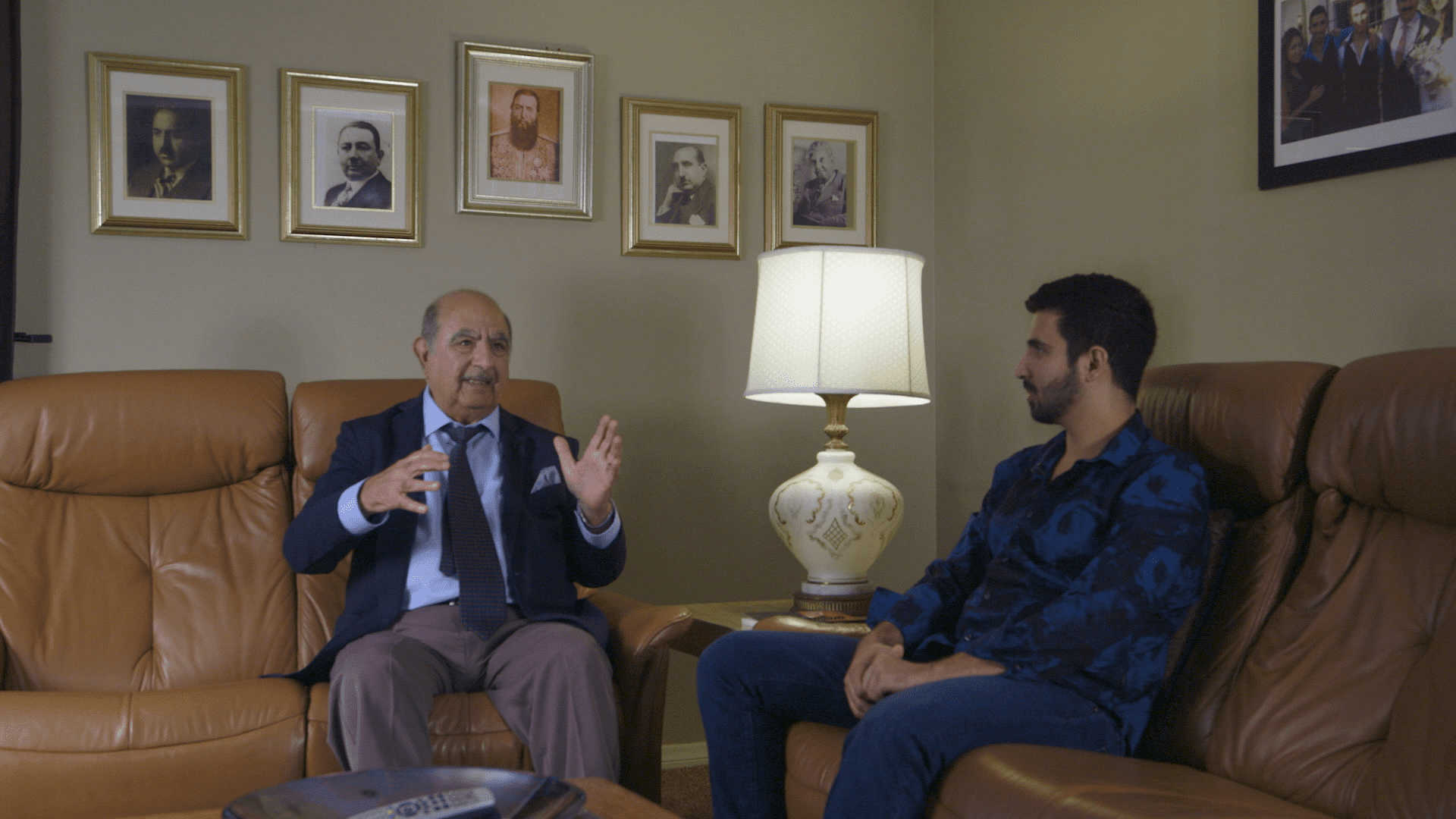
Adam Siddiq's Grandfather Khaled Siddiq
SIDDIQ: My grandpa was recently in between the hospital and medical rehab for nearly 6 weeks, struggling with pneumonia. He overcame his health challenges and is doing much better at his home now, where he's been recording the last 60 pages of his memoir in Farsi.
FQ: There are many ups and downs in the writing process; what was your favorite and most difficult aspect of embarking upon such a grand and honored task as writing your grandfather’s memoir?
SIDDIQ: My favorite part of writing Shackled was bonding with my grandpa and getting to know my ancestors. It was a very special experience to get to know the people behind so many of the pictures in the book. Also, as I mentioned in the author's note at the beginning of the book, I felt the presences of my ancestors as I'd write into the late hours of the night. This wasn't something that happened once, twice or even twenty times. This was something I experienced over the course of bringing this book to life. Experiencing that was sacred for me.
The most difficult aspect of writing this book...well, I'd say there were two difficult aspects. For one, it was challenging at times for my grandpa to open up with depth and detail about the tragic things he witnessed and experienced. This often took days, even weeks at times, for him to remember and share. I also had to be cautious of when I'd ask him such questions. I lived in his home for about a year during the majority of the writing process and the nights that I'd ask him questions about tragic events, I'd hear him have troubles sleeping as if he was remembering and experiencing those events as nightmares. So, I learned to ask those kinds of questions only in the mornings and to be very patient with his answering. The other difficult aspect of writing this book was acknowledging that this happened to my grandpa and our family.
Adam Siddiq with his grandfather
FQ: What motivated you to write his memoir?
SIDDIQ: Many things motivated me to write this memoir. The biggest thing of all is I felt I was guided to write this memoir, and I feel it's evident for others when they look at the facts in hindsight. For instance, it was a month after my sixth birthday that I first learned what happened to my grandpa and the entire family. It was a month after my grandpa's sixth birthday that the imprisonment began. It was about four months after my 25th birthday that Shackled was published. It was about four months after my grandpa's 25th birthday that he was released from imprisonment. My grandpa named me. My grandpa has written an abundance of poems and composed songs that have been sung by the most famous Afghan and Persian singers in the world. I was inspired by my grandpa to write books and poetry since I was a young kid and had been writing ever since. It's evident there's a bond beyond what I can imagine with my grandpa and me. It was after my grandma passed away that I knew I had to spend more time with my grandpa and to learn more about what my family went through, but based on the above facts, one can see how it was set in motion for me to collaborate with my grandpa on this project from very early on.
FQ: How did your family react to your decision to write about your grandfather’s past? Did they ever have any concerns about bringing up his past in his senior years?
SIDDIQ: My father's side of the family was very supportive of it. The main concerns they had were related to asking questions that elicited raw emotion and telling the stories of the tragedies he witnessed and experienced, given my grandpa's age and out of concern for his health.
FQ: In the book it mentions your grandfather eventually moved to California to be closer to his family. Did he face any challenges in his move from Germany to the United States?
SIDDIQ: No, my grandpa didn't face any challenges moving to the United States. If anything, it would be that he really loved life in Germany. He still misses it to this day. He's also natively fluent in German, where he's conversationally fluent in English, so it's easier for him to read, write, speak in German.
FQ: Shackled is divided up into parts I to IV and each one begins with an excerpt from one of your grandfather’s writings. I was especially interested in Part II entitled, “Open Your Intuitive Eyes.” Could you briefly tell readers more about your grandfather’s other writings? 
SIDDIQ: Absolutely! My grandfather is a poet, song composer, and author of several books, including the most comprehensive history book on Afghanistan over the past two centuries. Each part of Shackled contains a few verses from different poems my grandpa has published. My grandpa has also written a book about philosophy and mystic wisdom, covering all the great philosophers, mystics, and poets he's studied over the years with core lessons and teachings they provide.
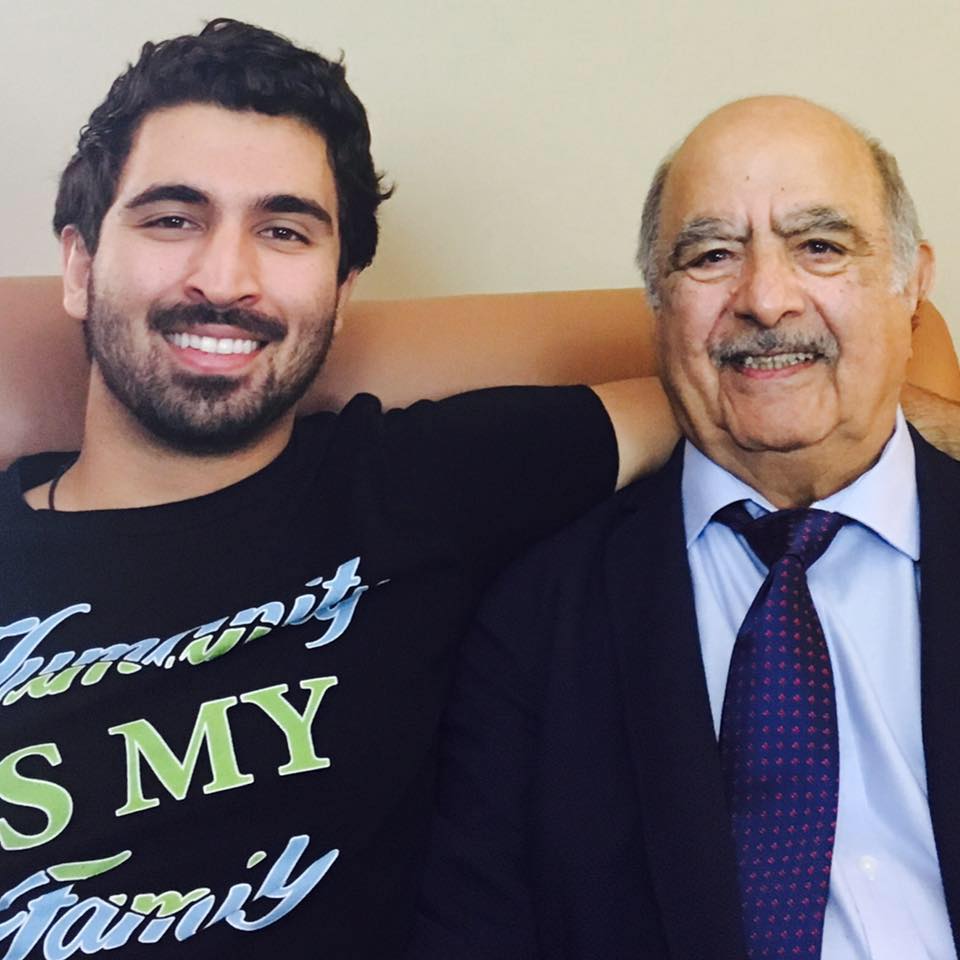
The author with his grandfather
FQ: I read on your Facebook page that you started a group entitled, “Humanity is My Family.” Can you explain to readers what this is, and why you decided to create the group?
SIDDIQ: I started the "Humanity Is My Family" group because I want to inspire more humanity in the world. I made two videos that showcased this message and went viral on social media. One was of me showcasing my DNA test results and it ends with my stating that humanity is my family, and then crossing out the word "my" and writing "our" above it. People all around the world loved this message so much that they've been using it in silent protests for human rights, transforming perspectives from hate to love and acceptance, and bringing their own humanity into the world. As far as from where I gained a strong sense of human rights, it's been something in my family lineage. The group has been steadily growing with people from around the world sharing their own personal stories.
FQ: Do you have any plans for future writings that readers can look forward to seeing?
SIDDIQ: Yes! I have several books in the works right now, including a fiction series! Of the non-fiction books I've been writing, one of them goes in depth with the theme of my podcast: living a soulfully optimized life (a life guided by purpose, contribution, and creating a profound impact for life). Another non-fiction book I've been developing is about modern-day interpretations and meanings from Rumi's poems, and how we can apply them to live a more love-inspired, magical life. As for the fiction series, all I can share for now is that the inspirations behind what I've been writing include Paulo Coelho, Khaled Hosseini, and J.K. Rowling.

Meet Author Adam Siddiq


Meet Author Adam Siddiq - author of Shackled

Check out his new author page on Feathered Quill 

#BookReview - Shackled @adammsiddiq

Shackled: A Journey From Political Imprisonment to Freedom

By: Adam Siddiq
Publisher: Lineage Publishing
Publication Date: December 2017
ISBN: 978-1946852007
Reviewed by: Lynette Latzko
Review Date: July 30, 2018
In the latter part of the 19th century, Commander-In-Chief Ghulam Haidar Khan Charki became a national hero with his successful efforts to peacefully unite all of Afghanistan. His four sons also became critical government figures, and together with the soon-to-be King, Prince Amanullah, they worked diligently on the arduous task of modernizing the outdated country of Afghanistan. These changes included such things as building relationships with Europe, abolishing slavery, and creating freedom and equality for women. Unfortunately, not everyone believed that King Amanullah’s plans were in the best interest of the country, and while he was overseas in 1929, a coup was developed and successfully forged against him. This led to thousands of people, many loyal to the original King, including the Charki family, to become political prisoners.
Author Adam Siddiq, Khaled Siddiq’s grandson composes a beautifully intense (often leaving this reader teary eyed) and inspiring true account of Khaled’s life that includes many touching family photos, and a solid account of Afghanistan’s turbulent history. The journey begins in 1932, when Khaled is a mere boy of six. His father, Ghulam Siddiq Khan Charki (son of Ghulam Haidar Khan Charki) is exiled, some of his uncles are executed, and his family is imprisoned in Kabul. Forced to barely survive in wretched conditions, Khaled and his family suffer from (and some succumb to) various preventable illnesses. However, instead of languishing in their misery and giving up hope for freedom, Khaled’s family, with the help of his aunt, decide to make the best of their situations by educating the young children. Over the decades of his imprisonment, Khaled was able to learn to speak fluently in several languages, and most importantly he was able to develop the patience, optimism, kindness and fortitude that would serve him immensely throughout the decades of his imprisonment, home confinement, and further struggles with the new Afghanistan government.
A few decades ago, I was a student nearing the end of my studies where our teacher was discussing the critical importance and utmost value of education. The teacher made a profound statement that really left a mark in my memories - he said, “They may take your cars and your possessions. They may foreclose on your home. The world may even do the unthinkable by taking away your family and loved ones, but what no one will ever be able to take away from you is your education. Once you have it, it is yours forever. No one can take that away from you.”
I thought about it, and eventually forgot about what was said that day. Fortunately, over the years, I never had to personally experience repeated and devastating loss, so my teacher’s profundity never truly struck home with me until many years later when I was deep into reading this memoir. Khaled Siddiq experienced substantial loss of his family, his family home and their possessions (and their trusted positions in the government) and most importantly his own freedom at the tender age of six. Yet through all this repeated devastation, he quickly learned the extreme value of education and was ultimately able to withstand years of abuse to, in essence, conquer an entire nation that was against him and his family, and win his complete freedom.
Quill says:  Shackled: A Journey From Political Imprisonment to Freedom, is a powerful true story of one man’s life in Afghanistan filled with raw emotion that is an inspiring must-read for all humankind.
For more information on Shackled: A Journey From Political Imprisonment to Freedom please visit the author's website at: www.adamsiddiq.com

Meet the Author - James C. McCullagh @ChuckMcCullagh


Meet Author James C. McCullagh, author of Chanting the Feminine Down - featheredquill.com/author-bios-james-mccullagh/

#BookReview - Chanting the Feminine Down @ChuckMcCullagh

Chanting the Feminine Down: A Psychological, Religious, and Historical Novel

By: James C. McCullagh
Publisher: CreateSpace
Publication Date: November 2017
ISBN: 978-1-979059909
Reviewed by: Amy Lignor
Review Date: July 30, 2018
Readers begin in the Bronx…behind a curtain.  There is, however, far more in regards to the “scenery” than you would imagine if you’re seeking a simple “girl in New York” tale. Which is exactly what would and should lead you to read on.
Her name is Colette McGovern and she is going through a time in life that is, by all rights, a choice, but a choice that she must live with for the end of time. She is also a graduate student in the field of Christian Theology. Her journey, so to speak, begins when Colette must choose a topic and put together her senior project for Professor Gleason. But the last thing Colette wants to do is really throw herself into the topic. As she, herself, states, she didn’t care if her topic was about the man on the moon, just so long as it was unexciting and at a time in history that was so far back no one would care too much about it. In other words, get the grade and get out…of both school and the Bronx, which is exactly what Colette is yearning to do. Thus, she picks the Council of Trent as her theme, and even Gleason could care less, thinking that particular period to be nothing more than confused and boring.
Colette’s mother’s name is Patricia. She is what some in today’s society would deem “a die-hard Catholic.” She knows the Latin Mass by heart, attends it regularly, and likes to speak at home in Latin, feeling as if it brings her closer to Colette’s father who has passed away. In addition, Mom also acts a bit like an Agatha Christie character, as if searching for clues to what her daughter’s temptations and sins really are.
Colette’s dreams at night are beginning to get highly haunting. One night she has a dream that truly confuses her and she decides to set up an appointment with the campus counselor, Mr. O’Connell, to see if he can offer any help. What Colette turns to more, however, is her dream journal; recordings made about what she sees and feels while sleeping. The scope of her visions include everything from negative feelings to historical time periods with a cavalcade of characters, and Collette (along with the reader) finds herself literally taking a trek through time.
Colette searches to better comprehend everything from the Council of Trent to Catholicism, to somehow reinstate or bring back her own spirituality which has dissipated. Utilizing everything from religious viewpoints to mythological beliefs, she strives to discover the feminine in Christianity. Only, she stumbles upon more questions as she attempts to gain the understanding she lacks in order to grow, mature, and live life to the fullest.
The writer has done an incredible job delving into subjects that are a bit hard to deal with. Through his character’s eyes, he also allows for beauty and richness from the mystical/mythological world to enter into the text in order to keep the story fresh, introducing people like Boccaccio and the Renaissance crowd. Readers see the struggle that Colette faces in a male-dominated religious landscape, and watch her meet up with and revel in the feminists who, throughout the ages, became true heroes who stood up against patriarchal societies and the Church during their lifetimes.
The title is completely factual for this drama that states it to be a “psychological, religious and historical” novel. Because after reading about Colette and her “travels,” you will completely see all three paths taken in order to create this extremely profound book.
Quill says: A well-done drama spotlighting provocative questions that still reside in the human consciousness today.
For more information on Chanting the Feminine Down, please visit the book's website at: http://chantingthefemininedown.com

#BookReview - It's a Firefly Night

It's a Firefly Night

By: Dianne Ochiltree
Illustrated By: Betsy Snyder
Publisher: Blue Apple Books
Publication Date: July 2018
ISBN: 978-1-60905-618-6
Reviewed by: Amy Lignor
Review Date: July 31, 2018
For any child, such as myself, who was raised in one of those rural areas where the brilliance of the stars in the sky were rivaled only by the stunning fireflies that flitted all about, this is the book for you. And if you are a city dweller and have not had the opportunity to see these charming little critters make the summer nights even more magical, this is definitely something your child would absolutely love to read and learn about.
In this sweet tale, Daddy and his little girl (and the little dog, too), see the summer nights as taking a journey into a world of wonder and imagination. The moon rises high in the sky, the stars beam to add their light, and Daddy calls it a “firefly night.” Going on a journey with her glass jar in hand, we race with the young girl and her pup as she zips over the grass and collects fireflies so that she can, quite literally, hold stars in her hand. When the collecting is done and the fun has been had, the girl opens the lid and watches those lovely creatures unfurl their wings and soar over the land.
The artwork in this book is truly lovely. From the excitement on the little girl’s face, to capturing that look of pure love and faith that a little girl and her father share, the artist has done a superior job of bringing these characters to light. In addition, this cover is one that will have the kids pulling this book off the shelf every night in order to see the glitter and glow of the fireflies. This is the perfect book for a child. You can even envision in your own mind that truly loving family sitting together with the beloved dog, the windows open so that the warm night breeze comes through, reading this great story. In addition, the author has placed information in the back of the book so that kids can learn all about those fireflies. The story involves a great way to first teach children how to count, and the book even offers arts and crafts ideas that kids would love to do.
Every decade has one. We all know this. Whether it be our favorites from our time that we still remember…Curious George, perhaps? A little bear called Pooh and his magical friends? Or, even that special Goodnight Moon that has kept children entertained over many, many decades, It’s a Firefly Night has the same beauty, kindness, and special “something” to be that book for this generation and many more to come.
Quill says: This is so well-written and fantastically illustrated that you’ll wish everynight was a Firefly Night!

Saturday, July 28, 2018

#BookReview - The Possibilities of Oneness

The Possibilities of Oneness: Doorways to Life's Deeper Meaning, Wonder, and Joy

By: Will Irons
Publisher: Wisdom Wellspring Publishing
Publication Date: January 2018
ISBN: 978-0999516607
Reviewed by: Anita Lock
Review Date: July 25, 2018
Will Irons pulls from his experiences to explore the “doorways to life’s deeper meaning, wonder, and joy” in his book The Possibilities of Oneness.
The author's connection with Universal Oneness begins at age five when his hunt for sweets leads him to find and swallow a sugar cube, which, unbeknownst to him, is laced with LSD. What follows is a day-long succession of eye-popping experiences: brilliant lights, and high-definition shapes and sounds, to name a few. While hallucinogenic substances can trigger similarly-related experiences, the point that Irons makes is that every person has the potential of experiencing Oneness without the use of substances.
Universal Oneness—that deep interconnectivity with the rest of the world—is not an uncommon concept with many vehicles (i.e., sports, nature, music) leading to it. Although Irons spends time describing his experiences, they serve only as a catalyst to the main points of his book, which are to raise awareness that several vehicles coupled with the experiences are more ordinary than one may think, to identify stages of awareness leading to Oneness, and then to provide thirteen circles of timeless wisdom that can be used as a practical and foundational daily-life guide.
Irons covers a brief explanation of the book’s outline, terminology, and aspects of his background before delving into chapter three: Degrees of Oneness—four degrees of mindfulness, namely, Ego, Flow, Wonder, and High Peak, that will lead to Oneness experiences. This chapter is a befitting precursor to Irons’s experiences, which he addresses over a set of chapters.
Unique to Irons’s writing style is the effective way he takes an often-described-ethereal topic and translates it into crisp and comprehensible language, “free of cultural or religious baggage.” Rich descriptions of his Oneness experiences via various relatable vehicles (i.e., hiking, snorkeling, and surfing to name a few) connecting him to nature transport readers into a realm that is undoubtedly mystical yet essential to one’s existence.
Irons balances his passionate read with the realities that come with a choice. While Oneness experiences are not planned events, aligning one’s lifestyle to practices of unification is a deliberate act—one that is filled with love and compassion. The flip side—on an extreme level—choosing an ego-based lifestyle can lead to a self-absorbed state of consciousness that is laced with “hatred, terrorism, mass shootings, the horror of death camps, environmental destruction, and genocide.”
The Possibilities of Oneness closes with priceless gems from others who have experienced Oneness followed by an in-depth explanation of Irons’s thirteen circles of timeless wisdom and how they can effectively be incorporated in one’s daily routine.
Quill says: The Possibilities of Oneness is a fitting read during troubled times.
For more information on The Possibilities of Oneness, please visit the author's website at: www.willirons.com